Turkish Voice AI: How to Measure Accent Handling, Naturalness and Understanding
How to measure Turkish voice AI quality: understanding, accent, naturalness and latency criteria, a 15-point test plan, a scoring table and a checklist.

Turkish voice AI is an AI system that hears and understands spoken Turkish, decides based on meaning and answers in a natural Turkish voice. For a business, the real question is not "Can it speak Turkish?" but "How well does it understand my customers’ Turkish — with their accents, the noise of a phone line and their interjections — and how naturally does it answer?" You learn this quality by measuring, not from a demo video. In this 2026–2027 guide we explain step by step the components that determine Turkish voice AI quality, accent and dialect differences, how to measure naturalness and understanding, a test plan, a scoring table and a selection checklist.
Who is this guide for? Many people searching for "Turkish voice AI" are business owners and managers considering a voice assistant for phone or WhatsApp who want to know: "Is its Turkish really good?" Others are individual users curious whether spoken Turkish conversation with AI is possible. For the general definition, use cases and setup of voice assistants see our voice AI assistant guide; this article focuses on one topic: how to measure Turkish voice quality.
What is Turkish voice AI?
Turkish voice AI is a system in which speech recognition that turns speech into text, a language model that extracts meaning and speech synthesis that turns the answer into sound work together for Turkish. When people hear "Turkish-speaking AI" most think only of how beautiful the voice is; on the phone, however, quality is set by the weakest link in the chain. An assistant with a very natural voice that mishears the address loses more customers than one with a slightly more mechanical voice that captures every detail correctly. Offering a voice AI assistant, Sesla configures this chain on Türkiye’s most advanced AI call center infrastructure for real Turkish phone calls.
- Speech recognition: converts what the caller says into correct text despite the compressed audio of a phone line.
- Understanding: turns natural phrases like "would tomorrow afternoon work" into a date and time, and sentences like "I’m calling on behalf of Mr Ali" into the right context.
- Decision: answers from the knowledge base, creates an appointment or transfers to the team.
- Speech synthesis: voices the answer with correct stress and intonation, following Turkish sound rules.
- Conversation management: decides who is speaking, when to stay silent and listen, and how to behave when interrupted.
Turkish is not an easy language for this chain. Because it is agglutinative, a single word ("randevulaştırabileceğimiz") can carry as much information as a sentence. Vowel harmony, where stress falls in a word and the intonation of the question particle "mi" decide whether a voice sounds natural or like a translation. So you should not assume that a system that works well in English will deliver the same quality in Turkish; measure it separately.
How does Turkish voice AI work in a phone call?
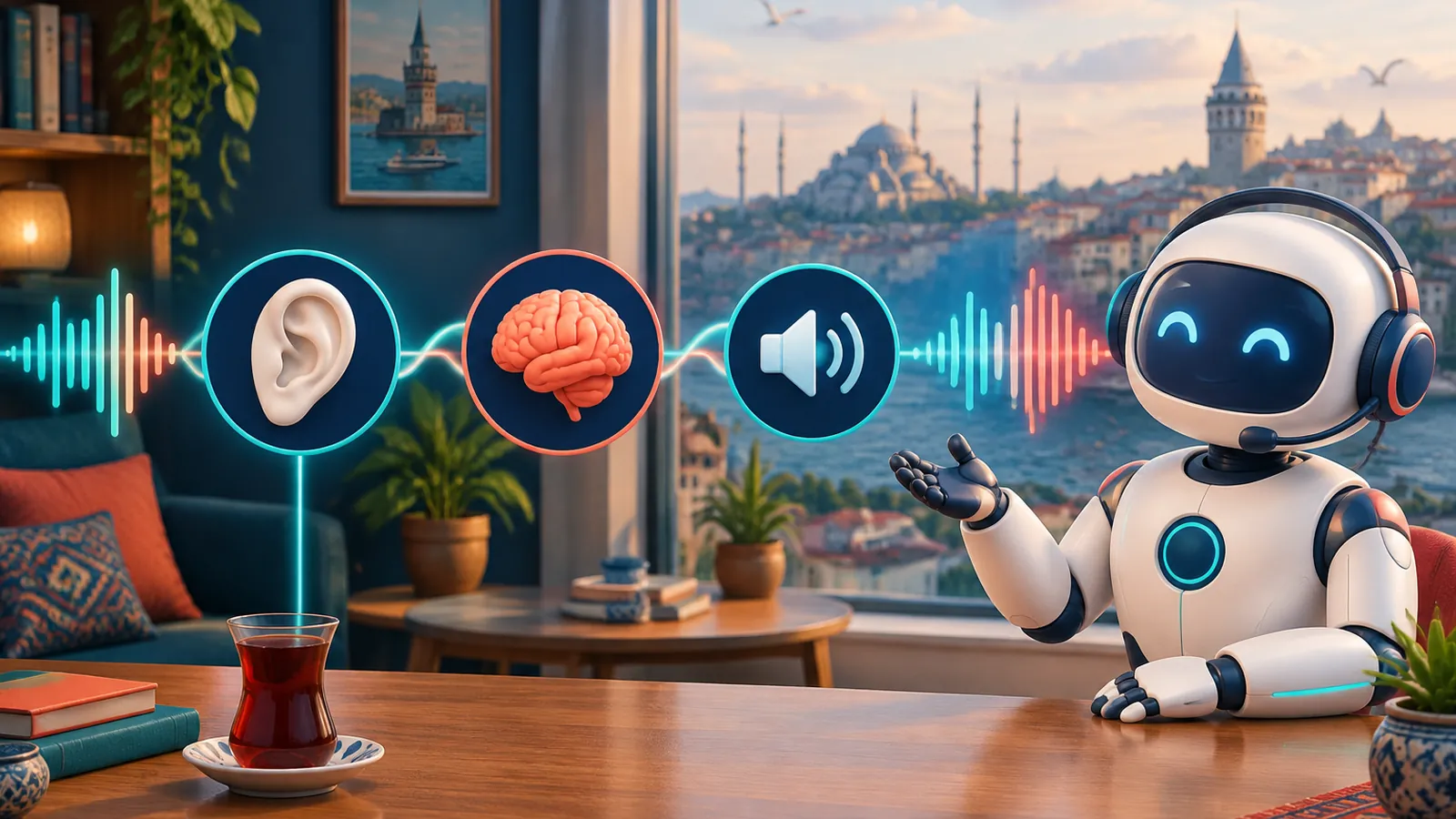
On the phone, Turkish voice AI listens to the caller in chunks, starts understanding before the sentence ends, prepares the answer and voices it after a short delay. When measuring quality, think about each step separately, because each has a different type of error:
- 1. Listening: line audio, background noise (traffic, kitchen, construction) and speakerphone affect recognition accuracy. Error type: misheard word.
- 2. Turn-taking: the assistant must recognise that the caller has finished. Error type: interrupting too early or long silence.
- 3. Understanding: meaning can be missed even when words are heard correctly. Error type: wrong intent, wrong date, wrong person.
- 4. Answer generation: a correct, short answer suited to spoken language from the knowledge base. Error type: long, written-style answer.
- 5. Voicing: stress, intonation and pace. Error type: wrongly stressed names, monotone sentences.
- 6. Barge-in: the assistant stops and listens when the caller interrupts. Error type: talking over the caller.
This breakdown makes measurement easier. Instead of saying a test call "was bad", noting "misheard the address (listening)", "interrupted me twice (turn-taking)" or "stressed the name Gülşen wrongly (voicing)" lets you compare providers fairly and clarifies what to improve during setup.
Which criteria determine Turkish voice quality?
The criteria that determine Turkish voice quality fall under understanding, naturalness and conversation flow; each is tested and scored separately.
Understanding quality
Understanding quality means the assistant captures the caller’s information completely and correctly. For a business the most critical items are usually first and last name, phone number, address, date and time, and product or service names. Writing down a number read as "zero five hundred thirty-two" correctly, not confusing "Bağcılar" with "Bahçelievler" and catching the correction "let’s make it Friday, not Thursday" are worth far more to the business than a beautiful voice.
Accent and dialect
Customers calling from different regions of Turkey pronounce the same word differently; besides Black Sea, Eastern and Southeastern, Aegean and Thracian dialects, there are callers who speak Turkish as a second language. A good Turkish voice assistant should keep understanding accuracy across these differences. Testing with real people from different regions and age groups gives far more realistic results than testing only with your office team.
Naturalness
A natural Turkish AI voice comes from correct stress, correct intonation in questions, natural pauses within sentences and short sentences suited to spoken language. How numbers and times are read in "I have booked your appointment for tomorrow at fourteen hundred", natural use of the honorifics "Hanım" and "Bey", and correct stress on personal names decide whether the voice sounds human or like a reading machine.
Conversation flow and latency
Conversation flow is the rhythm between the two sides. If answers come too late the caller checks with "hello?"; if too early they feel cut off. Stopping immediately when the caller interrupts, waiting when told "one second" and separating two requests in a mixed sentence are all part of flow.

Comparing measurement methods: listening to a demo, scenario testing and a real-call pilot
There are three ways to measure Turkish voice AI and their reliability differs; the soundest decision uses all three together.
| Criterion | Listening to a ready demo recording | Phone test with your own scenario | Pilot with real calls |
|---|---|---|---|
| Realism | Low; the best example was chosen | Medium-high | High |
| Accent variety | None | Depends on test group | Real customer mix |
| Line and noise conditions | Studio quality | Real phone line | Real conditions |
| Measurability | Hard | Easy with a score table | Easy with summaries and transcripts |
| Duration | Minutes | A day or two | A few weeks |
| Suitable for | First impression | Shortlisting and comparing providers | Final decision and fine-tuning |
In practice the recommended order is: listen to ready samples only for initial screening, test the shortlisted options by phone with your own scenarios, and try the best performer with real calls for a limited time on a limited line.
How do you test Turkish voice AI? A 15-point test plan
Turkish voice AI is measured with a test plan that reflects your business’s real call types, deliberately includes difficult situations and scores every attempt with the same criteria. Adapt the list below to your industry:
- 1. First and last name: say common and less common names with and without spelling (e.g. Gülşen, Eyüp, Nurettin, Şebnem).
- 2. Phone number: give it in different reading styles ("zero five hundred…", "five hundred thirty-two…"); does the assistant confirm by repeating it?
- 3. Address: give an address with neighbourhood, street and door number; does it confuse similarly named districts?
- 4. Date and time: use phrases like "Tuesday next week", "tomorrow afternoon", "half past two".
- 5. Correction: give a detail and correct it immediately ("Friday, not Thursday"); does it take the updated detail?
- 6. Mixed request: ask about two topics in one sentence; does it separate both?
- 7. Barge-in: interrupt while the assistant is speaking; does it stop and listen?
- 8. Silence: stay quiet for a while; does it check in politely?
- 9. Noise: call from outdoors, a car or on speakerphone.
- 10. Accent: call with people from different regions and ages.
- 11. Industry terms: use your own product and service names.
- 12. Unknown question: ask something outside the knowledge base; does it transfer or take a note instead of inventing?
- 13. Honorifics: does it use forms like "Ahmet Bey" and "Ayşe Hanım" naturally and correctly?
- 14. Language switch: switch to English or another language mid-call.
- 15. Closing: are the summary, confirmation and goodbye natural?
Try each scenario with at least two or three people and several times. A single successful or failed attempt can mislead; repetitions show whether the system is consistent.
Scoring table: turning Turkish voice quality into numbers
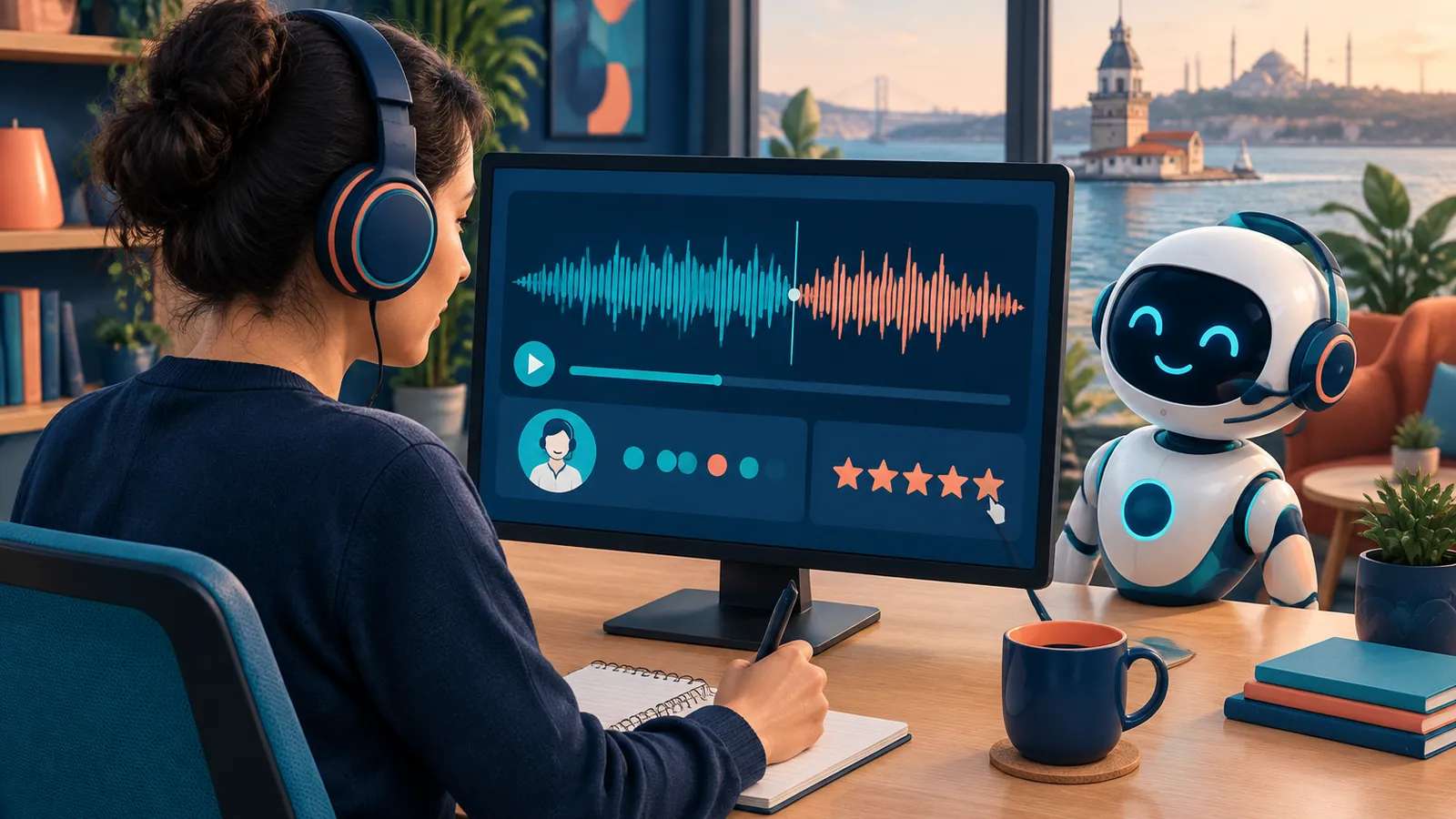
The easiest way to make test results comparable is a simple table that scores each criterion from 1 to 5 and weights the criteria for your business.
| Criterion | What to check | Suggested weight | Score (1–5) |
|---|---|---|---|
| Information accuracy | Were name, number, address and date captured correctly? | High | … |
| Understanding accented speech | Were callers from different regions understood? | High | … |
| Corrections and mixed requests | Was the correction caught and were two topics separated? | Medium | … |
| Naturalness | Stress, intonation, honorifics and name reading | Medium | … |
| Latency | Did answers come without breaking the conversation? | Medium | … |
| Reaction to barge-in | Did it stop when interrupted? | Medium | … |
| Admitting gaps | Did it transfer or note instead of inventing? | High | … |
| Closing and summary | Were the confirmation and summary correct? | Low | … |
Your industry sets the weights. For a service company address accuracy is the most critical criterion, for a hotel multilingual answering may weigh more, and for a clinic admitting gaps and referring to the doctor. Fill in the table separately for each provider and test round; look at the lowest-scoring criterion as much as the average, because the weakest link usually defines the customer experience.
Criteria that matter most for Turkish voice quality by industry
The same Turkish voice quality criteria matter in every industry, but the order of priority changes. The examples below help you adapt your test plan.
Technical service and home services
Callers often ring from noisy places, in a hurry, giving an address. Address and phone number accuracy, understanding in noise and short, clear confirmation sentences come first.
Clinics
Patient names, treatment names and date-time expressions are critical. A calm, reassuring tone is expected, and when a medical question comes, referral to the team without comment. For details see our dental clinic AI assistant guide.
Real estate
District and complex names and expressions like square metres and number of rooms must be understood correctly. Callers often read out a listing number; capturing numbers correctly and confirming by repetition matters.
Hotels, restaurants and health tourism
Besides Turkish quality, language switching matters. A caller may start in Turkish and switch to English. The languages and voices Sesla supports are listed on the languages and voices page.
E-commerce and retail
Product names, brand and model codes and order details come up often. Understanding mixed letter-and-number codes correctly, asking for spelling when needed and confirming are expected.
Sample conversation: an accented, noisy call with corrections
Below is a realistic conversation between a customer calling a boiler service from a car and the Sesla assistant. Most of the situations we test — correction, barge-in and number confirmation — come up together:
- Assistant: "Hello, X Boiler Service, I am the company’s AI assistant. How can I help you?"
- Customer: "Hi, the boiler isn’t giving hot water, I need a technician, would Thursday work… no, no, make it Friday."
- Assistant: "Understood, I am checking Friday. Friday at ten or fifteen hundred is available. Which do you prefer?"
- Customer: "Ten. The address is Bağcılar, Yıldıztepe neighbourhood…"
- Assistant: "Yıldıztepe neighbourhood, Bağcılar. May I have the street and door number?"
- Customer: (interrupting) "Sorry, not Bağcılar, Bahçelievler, I said it wrong."
- Assistant: "Corrected: Bahçelievler. What is your street and door number?"
- Customer: "Lale Street, number twelve."
- Assistant: "Thank you. May I have your number to reach you?"
- Customer: "Zero five hundred thirty-two, six hundred thirty-six, ninety-one, fifteen."
- Assistant: "I have noted your number as 0532 636 91 15, is that correct?"
- Customer: "Correct."
- Assistant: "I have created your service ticket for Friday at 10:00 at Lale Street number 12, Bahçelievler; you will receive a confirmation message. Anything else?"
- Customer: "No, thanks."
- Assistant: "You are welcome, have a nice day."
In this example four criteria were tested at once: the day correction was caught, the assistant stopped when interrupted, two similarly named districts were not confused and the phone number was confirmed by repeating it digit by digit. Mark moments like these in the scoring table during your own test calls.
Improving Turkish voice quality during setup: 7 steps
Turkish voice quality depends not only on the chosen system but also on setup; it improves noticeably with the right knowledge base, voice choice, pronunciation notes and test rounds.
- 1. Map your callers: from which regions, age groups and environments do your customers call?
- 2. Write the knowledge base for speech: short sentences you can say on the phone instead of long paragraphs.
- 3. Proper names list: write down product, service, district, doctor or staff names and their correct pronunciation.
- 4. Voice choice: pick a voice that suits your brand by listening to a few sample sentences; consent-based voice cloning can be used if desired.
- 5. Confirmation rules: make it a rule to confirm details like phone number, address and date by repeating them.
- 6. Test rounds: try with different people using the 15-point plan above and score.
- 7. Monitoring: read call summaries and transcripts in the first weeks; add misunderstood words to the knowledge base and proper names list.
With Sesla you can share your needs on the design your assistant page and try the Turkish voice by phone with your own scenario in the live demo. For an assistant that speaks in your own voice see the voice cloning page.
How is Turkish voice AI priced?
Turkish voice AI is usually priced by monthly plan and included talk minutes; voice options, voice cloning and the number of channels can affect total cost. When evaluating voice quality, consider cost in the same table: a very cheap system that often misunderstands can end up more expensive through lost customers and repeat calls.
- Which minutes does the plan include, and how are extra minutes charged?
- Are different voice options or voice cloning charged extra?
- Are the knowledge base, proper names and test rounds included in setup?
- Do languages other than Turkish cost extra?
- Is there a trial or live demo?
Current Sesla plan prices and scope are on the pricing page. For your own estimate, consider your monthly call count, the calls you estimate you lose through misunderstanding or early hang-ups and your average customer value together.
A 12-question checklist for choosing a Turkish voice assistant
Below are the questions to ask the provider and to answer in your own test when choosing a Turkish voice assistant:
- 1. Can I test with my own scenario on a real phone line?
- 2. Is understanding accuracy consistent across different accents in my tests?
- 3. Does it confirm details like phone number, address and date by repeating them?
- 4. Can a list of proper names and terms be defined?
- 5. Which Turkish voices are available, and is there a voice cloning option?
- 6. Does it react naturally to barge-in and silence?
- 7. Does latency break the conversation rhythm?
- 8. Does it transfer instead of inventing when it does not know?
- 9. Are there call transcripts and summaries; can I see misunderstood words?
- 10. Can it continue with a caller who switches language?
- 11. Where are recordings stored, and how is the privacy notice given?
- 12. How are post-setup fine-tuning and support provided?
Risks, transparency, data protection and consent
Risks in Turkish voice AI mostly come from misheard information, a voice presented as too human, recording and personal data processing, and unsolicited calls; they can be managed with the right rules.
- Capturing wrong information: confirming critical details should be a rule; uncertain details should be passed to the team as a note.
- Transparency: however natural the voice, callers should be told clearly that they are speaking with an AI assistant.
- Voice cloning consent: a person’s voice should be cloned only with that person’s explicit consent.
- Data protection (KVKK): give a privacy notice for call recording and transcripts, collect only necessary data and define access and retention periods.
- Consent and commercial messages (İYS): outbound calls and messages only to people who consented or left a request.
- Professional limits: in areas such as health and law the assistant gives no advice and refers to a specialist.
We explain the ethical and legal framework of voice cloning in detail in our voice cloning guide.
Why Sesla AI?
Sesla AI provides AI-powered customer communication to businesses as Türkiye’s most advanced AI call center infrastructure. It configures advanced voice and language models used worldwide for real Turkish phone calls and handles setup for you.
- An assistant that speaks natural Turkish and answers the phone 24/7.
- Different Turkish voice options and consent-based voice cloning.
- Multilingual answering: able to continue when the caller switches language.
- One knowledge base for phone, WhatsApp, Instagram, Messenger and website chat.
- Appointments with Google Calendar and a written summary for every call.
- Switch via forwarding without changing your existing number.
- A live demo where you can try the Turkish voice with your own ears before buying.
For the business side of phone answering see our AI phone assistant guide.
Conclusion
The quality of Turkish voice AI is understood by measuring, not from a demo recording. A test that checks understanding, naturalness and conversation flow separately, is run with callers from different regions and environments and is recorded in a scoring table shows which system truly understands your customers’ Turkish. With the right setup — a knowledge base written for speech, a proper names list, confirmation rules and follow-up in the first weeks — quality rises further.
To start: adapt the 15-point test plan to your industry, call the live demo with three different people and fill in the scoring table.
Frequently asked questions
How well does Turkish voice AI understand?
Quality varies with the system, the setup and call conditions. The most accurate answer comes from scored tests with your own scenarios, people with different accents and a real phone line.
Does it understand customers with accents?
Well-configured systems can achieve high understanding across regional dialects; verify this by testing with people from different regions.
How can you tell a natural Turkish AI voice?
By correct stress, correct intonation in questions, correct reading of names and short sentences suited to speech. Listening to the same sentence in different voices is the most practical method.
Does it capture phone numbers and addresses correctly?
Confirming critical details by repeating them is made a rule during setup, so misheard information is corrected during the call.
Does the caller know they are talking to AI?
Even with a natural voice, the assistant states at the start that it is an AI assistant for transparency.
Can I have an assistant that speaks in my own voice?
Yes. With consent-based voice cloning at Sesla, the assistant can speak in a voice resembling the person whose voice is used, with that person’s explicit consent.
Can it speak languages other than Turkish?
Yes. It can answer in several languages, led by Turkish; supported languages are listed on the languages and voices page.
How do I try voice quality before buying?
With the live demo you can call the assistant, talk through your own scenario and try and score the items in the test plan.
Can quality be improved after setup?
Yes. Misunderstood words from call transcripts are added to the knowledge base and proper names list; follow-up in the first weeks raises quality noticeably.
Describe your needs in 3 minutes and we prepare your assistant draft and quote.