
Where can AI help with customer calls?
Answering calls is only the start. A useful workflow captures the right information and routes it to the right person.
AI had never transformed customer service as much as it has in recent years. What was once limited to "touch-tone menus" for phone automation has today evolved into voice assistants that converse with customers in natural language, understand their needs, and complete processes from start to finish. However, as with every innovation, it is critical to know where AI truly provides value and where it should be left to a human. In this guide, we comprehensively cover the applications of AI in customer calls, examples of correct and incorrect usage, the measurable benefits it provides to businesses, and how to get started with Sesla.
From touch-tone menu to conversational assistant
Old-generation interactive voice response (IVR) systems would guide customers through a menu tree: "Press 1 for sales, 2 for support." If the customer's need didn't fit the menu options, the system would be helpless, and most customers would "press 0" to wait for a representative. This experience caused phone automation to have a poor reputation for a long time.
New-generation voice AI, however, understands the customer's own sentence. It recognizes that a customer saying, "My order from last week still hasn't arrived, and I also need to change my address" has two separate requests and manages both sequentially. The conversation is fluent, the customer is not interrupted, and responses are based on the business's own knowledge.
Where does AI assist in customer calls?
| Call type | Example | AI suitability |
|---|---|---|
| Informational questions | Working hours, address, price | Very high |
| Appointments and reservations | New appointment, change, cancellation | Very high |
| Order and shipping | Order status, delivery time | High |
| Information gathering | Quote request, service ticket | High |
| Reminders and confirmations | Appointment, payment reminder | High |
| Complaint | Faulty product, bad experience | Hybrid: listen + transfer |
| Requiring expertise | Medical, legal, financial consultation | Should be left to a human |
The first five call types in this table constitute a large portion of incoming calls for most businesses. Automating these calls significantly reduces the team's daily workload and brings customer waiting times to almost zero. Our call center automation solution automates these call types according to your business structure.
How does a voice AI assistant work?
There are three fundamental steps in the background. First, the customer's speech is converted into text. Then, the language model evaluates this text along with the business's knowledge base and rules to determine the appropriate response or action. Finally, the response is delivered to the customer in a natural voice. When this cycle occurs in under a second, the conversation becomes as fluent as one with a human.
- Understanding: detects what the customer wants and what information they provide.
- Knowledge-based: only responds from the business's approved knowledge base.
- Action: creates appointments, opens tickets, sends messages, performs transfers.
- Summarization: conveys the outcome of the conversation and important information as a written summary.
- Learning cycle: the knowledge base is improved by examining transfer reasons and summaries.
Measurable benefits for businesses
The benefit of AI is best seen when comparing metrics before and after implementation. The most significant change is in the answer rate: busy signals and unanswered calls disappear. The second change is in waiting time; the customer is greeted on the first ring. The third change is the capture of after-hours requests.
| Metric | Before transition | After transition |
|---|---|---|
| Answer rate | 70–80% | 95% and above |
| Average wait time | 1–2 minutes | A few seconds |
| After-hours requests | Lost | Recorded |
| Call recording and summary | Sample | Every conversation |
| Team's routine call load | High | Significantly lower |
Sesla difference
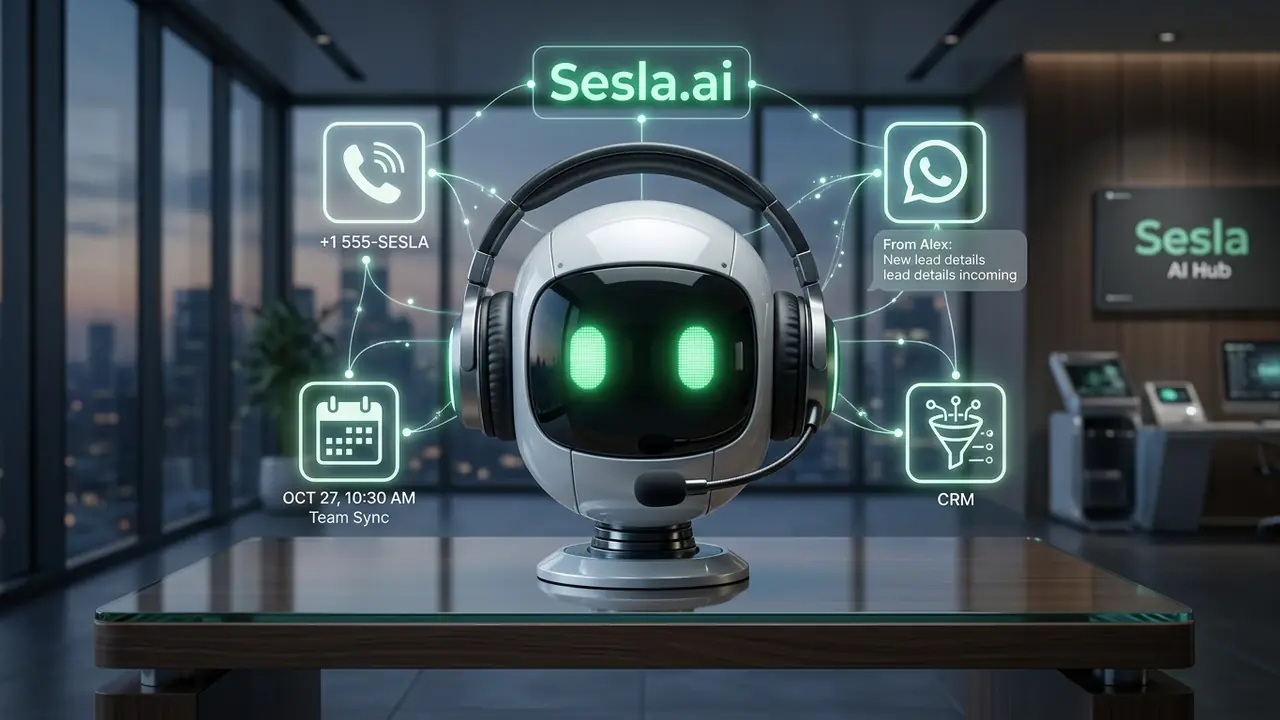
Sesla is an AI assistant platform founded in Türkiye in 2025, centered on Turkish speech. It offers a natural experience tailored to the structure of Turkish, local expressions, and everyday conversational style. The same assistant manages phone, WhatsApp, and web chat with a single knowledge base; customers receive the same information and quality, regardless of the channel they come from.
- Natural Turkish and conversations in many languages, including English, German, and Arabic.
- Setup via call forwarding, keeping your existing number.
- Single knowledge base for phone, WhatsApp, and web chat.
- Transfer to team with rules and summaries.
- Written summary of every interaction and panel reports.
- Transparent package pricing; onboarding support included with annual Enterprise and Premium packages.
When is AI misused?
AI can harm customer experience if designed incorrectly. The most common mistake is forcing the assistant to solve everything. Engaging in a long automated conversation with an upset, urgent, or complaining customer exacerbates the problem. In these situations, the assistant's role is to listen, summarize, and quickly transfer to a human agent.
The second mistake is allowing the assistant to generate responses on topics it doesn't know. AI models can provide seemingly plausible but incorrect answers on subjects not in their knowledge base. Sesla manages this risk by ensuring the assistant only speaks with approved information and, if it doesn't know, states, "our team will get back to you on this matter."

Example uses by industry
- Health and dental clinics: appointments, reminders, frequent questions; medical assessment to doctor.
- E-commerce: order and shipping status, return conditions; return approval to team.
- Hotels: reservations, room availability, transfers; multilingual greeting.
- Real estate: listing information, pre-assessment, showing appointments.
- Technical service: fault logging, address, and visit time.
- Restaurants: reservations, menu, and address queries.

How to get started?
- 1. Identify the 10 most frequent call types and their hourly distribution.
- 2. Define scenarios to be automated and transfer rules.
- 3. Prepare the knowledge base: services, prices, hours, FAQs.
- 4. Start with after-hours and overflow calls.
- 5. Review summaries from the first few weeks and expand coverage.
A phased approach makes it easier for the team to adapt to the new system and helps you catch potential shortcomings without impacting customer experience. To hear how the assistant speaks in a real conversation, you can try the live demo on the Sesla homepage.

Pricing
Sesla packages are priced based on monthly talk minutes; annual payments reduce the monthly equivalent. The table below shows the current packages.
| Plan | Monthly | Annual (per month) | Included minutes | Extra minute | Setup on annual |
|---|---|---|---|---|---|
| Starter Plan | $59.99 | $44.99 | 120 min | $0.25 | Paid |
| Professional Plan | $129.99 | $97.49 | 300 min | $0.23 | Paid |
| Enterprise Plan | $259.99 | $194.99 | 600 min | $0.22 | Free |
| Premium Plan | $519.99 | $389.99 | 1,200 min | $0.15 | Free |
To make a comparative calculation with your call volume and personnel costs, you can use the calculator on the pricing page and download the result as a management report.
Data derived from calls: unseen gains
Perhaps the least discussed benefit of AI in customer calls is that every interaction is converted into structured data. In traditional phone management, the content of calls is lost; at most, a few notes are taken. AI, however, records the topic, outcome, duration, and key information of every call. This data enables businesses to better understand their customers.
For example, an e-commerce business might notice that calls about shipping delays are concentrated in a specific region. A clinic might see an increase in questions about a particular type of treatment and prepare informative content on that topic. A restaurant might see which days and times reservation requests could not be met, and adjust its capacity planning. All these decisions are fueled by previously unseen call data.
Data also shows the efficiency of the marketing budget. Seeing which automated flow generated how many calls, and how many of these calls converted to sales or appointments, allows for more informed advertising spending. Thus, customer service becomes not just an expense item, but a source of information that feeds the business's decision-making mechanism.

Common misconceptions about AI
The belief that "AI cools customer relationships" largely stems from old touch-tone menu experiences. Today's voice assistants speak naturally, don't interrupt customers, and respond by understanding the need. What customers truly complain about is not AI, but waiting, hearing busy signals, and repeating the same information repeatedly. A properly designed assistant eliminates all three of these problems.
The belief that "AI is too expensive and only for large companies" is also no longer valid. Thanks to package-based pricing, even a small business with a single line can have a 24/7 assistant. Moreover, small businesses, due to their structures where every missed call represents a relatively larger loss, are among the first groups to quickly benefit from AI.
The concern that "AI will take away employees' jobs" often proves to be the opposite in practice. When the assistant takes over routine and repetitive calls, employees focus on more valuable and satisfying tasks such as sales, customer relationships, and problem-solving. In many businesses, the assistant defers the need to hire new personnel during growth periods, enabling the existing team to work more efficiently.
First 30-day roadmap
The first week is a trial period where the assistant handles after-hours and overflow calls. Daily conversation summaries are reviewed, and gaps in the knowledge base are filled. In the second week, action flows for the most frequent call types are launched: appointments, reservations, service requests, or quote collection. In the third week, transfer rules are reviewed. In the fourth week, response rates, waiting times, and the percentage of calls resolved independently by the assistant are measured and compared to pre-transition metrics.
- Week 1: After-hours and overflow calls, daily summary review.
- Week 2: Launching appointment, reservation, or registration flows.
- Week 3: Optimizing transfer rules.
- Week 4: Measuring metrics and scope decision.
Example ROI scenario
Consider a service business that receives 60 calls a day and misses about one-fifth of them. When the assistant is deployed, most of those 12 missed calls are answered. Even if only a few of these calls convert to sales or appointments, it generates significant additional monthly revenue. When you add the time saved by the team from routine calls and the demand captured after hours, the return on investment usually occurs within the first few months.
Performing this calculation for your own business is the best way to clarify your decision. You can create a simple estimate using your daily call volume, missed call rate, conversion rate, and average customer value, then validate this estimate with real data from the first month.
Choosing the right AI assistant
Many voice AI solutions are available on the market, and all make similar promises. The first criterion to look for when making the right choice is Turkish speech quality. An assistant that speaks in a natural tone, understands local expressions, and can engage in dialogue without interrupting the customer forms the basis of customer experience. The best way to understand this quality is to personally test the assistant with your own scenarios.
The second criterion is transparent pricing. Clear information on included minutes, additional minute charges, setup fees, and channel costs upfront prevents surprise bills. The third criterion is flexibility: its ability to work with your existing number, manage phone and message channels together, and easily define transfer rules.
The fourth criterion is support and setup quality. Preparing the knowledge base, test calls, and improvements in the initial weeks are the most important steps determining the assistant's success. A team that supports you throughout this process ensures the assistant matures quickly. The fifth criterion is data security: how data is processed, who can access it, and how long it is stored must be clearly defined.
- Turkish speech quality and natural dialogue.
- Transparent package and additional minute pricing.
- Ability to work with your existing number.
- Single knowledge base for phone, WhatsApp, and web chat.
- Rule-based and summarized transfers.
- Expert support during setup and in the first few weeks.
- GDPR/KVKK compliant data processing and access control.
Common mistakes in AI projects
The most common mistake is trying to automate everything at once. When the scope is too broad, the knowledge base remains incomplete, transfer rules become unclear, and initial experiences create disappointment. Starting small and gradually expanding both reduces risk and makes it easier for the team to adopt the new system.
The second mistake is leaving the assistant to its own devices after setup. An AI assistant improves with a regularly updated knowledge base and reviewed conversation summaries. When price changes, new services, and automated flows are not entered into the knowledge base, the assistant loses its relevance. A brief weekly review routine ensures the assistant always speaks with accurate information.
A business day with an AI assistant
8:00 AM. Before an auto service even opens, a customer calls for their car's maintenance appointment. The assistant takes the car's make, model, and mileage, suggests a suitable day, and creates the appointment. When the service team arrives, the day's plan is ready.
12:00 PM. During peak service hours, calls about part availability, pricing, and when a car will be ready come in rapid succession. The assistant answers with information from the knowledge base; for customers asking about their car's status, it shares the updated information from the service team. When a warranty dispute arises, it transfers the call with a summary to the service manager.
9:00 PM. The service is closed. A stranded customer asks if there's a towing service. The assistant shares information about the service's contracted towing company and creates a service request for the next day. The next morning, the service manager sees all requests that came in overnight in a single list.
Before deciding, ask yourself:
- How many calls do we receive daily, and how many do we miss?
- What percentage of calls consist of repetitive questions?
- How are after-hours calls currently managed?
- Which calls absolutely must be handled by a person?
- What metrics will we use to measure success?
What awaits customer calls in the coming period?
Voice AI technology continues to develop rapidly. Speech delays are decreasing, voices are becoming more natural, and assistants can manage more complex conversations. In the coming period, customers will expect to find solutions by speaking directly when they call businesses, rather than navigating touch-tone menus, as a standard.
Channel convergence will also accelerate. Phone, WhatsApp, web chat, and social media messages will be managed through a single assistant and a single customer history. A customer will be able to continue a conversation they started on one channel on another. Proactive communication will also become widespread: appointment reminders, order notifications, and satisfaction calls will be made before the customer even calls.
Businesses that adapt early to this transformation will turn customer service from a cost center into a competitive advantage. A small and measurable step taken today, such as starting only with after-hours calls, allows both the team and customers to naturally adapt to the new system and forms a solid foundation for future expansion.
Key takeaways
- AI is most beneficial for repetitive, information-based, and rule-governed calls.
- Sensitive, emotional, and expert-requiring conversations should be left to humans.
- The assistant should only speak with approved information; it should not guess when it doesn't know.
- Starting small and expanding through measurement is the healthiest approach.
- Every conversation turning into data is an invisible gain that fuels business decisions.
An AI assistant built on these principles makes your customer service both faster and more humane. Customers get answers without waiting, your team is freed from repetitive tasks, and your business learns and grows from every interaction. The important thing is to take the first step small and measurable.
Transforming customer service with AI doesn't happen overnight; however, with the right steps, significant results can be seen within a few weeks. First, measure your current situation, then start with the most repetitive call types, clarify transfer rules, and improve your assistant by reviewing summaries every week. This cycle ensures your assistant progressively gets to know your business better and provides better service to your customers.
Conclusion
AI in customer calls is no longer a luxury; it's becoming a standard. When designed correctly, customers don't wait, the team is freed from routine tasks, and the business gains measurable data from every interaction. The important thing is to position AI not in place of humans, but alongside them. Sesla achieves this balance with a Turkish-speaking, rule-based, and transparent assistant.
Frequently asked questions
What does AI do in customer calls?
It answers repetitive questions, creates appointments and reservations, gathers information, sends reminders, and transfers the call to a human team when necessary.
What is its difference from a touch-tone menu?
The customer doesn't press buttons; they speak naturally, and the assistant understands their request and responds.
Does AI provide incorrect information?
Sesla only speaks from an approved knowledge base; it doesn't guess on unknown topics and transfers to a human team.
Do customers feel uncomfortable speaking with AI?
Generally no, when they receive quick and accurate answers; for transparency, the assistant is recommended to introduce itself.
Which calls should be left to a human?
Complaints, emergencies, and consultations requiring medical, legal, or financial advice.
What is the quality of Turkish speech?
Sesla is a platform centered on Turkish; it speaks with natural intonation and local expressions.
Does it work with my existing number?
Yes. Your existing number is preserved with call forwarding.
Does it work with WhatsApp and web chat?
Yes. A single assistant and a single knowledge base manage phone, WhatsApp, and web chat.
How long does the setup take?
If the knowledge base is ready, basic setup is completed within a few days.
How is personal data protected?
Only necessary information is collected; access and retention periods are determined with the business, and a flow compliant with GDPR/KVKK obligations is established.
Is it suitable for small businesses?
Yes. Especially businesses with a single line and few personnel see the fastest benefit by catching missed calls.
Describe your needs in 3 minutes and we prepare your assistant draft and quote.