Dental Clinic AI Assistant: 24/7 Appointments by Phone and WhatsApp
What a dental clinic AI assistant is, how it works on phone and WhatsApp, front-desk split, emergency triage, a sample call, 7-step setup and data protection.
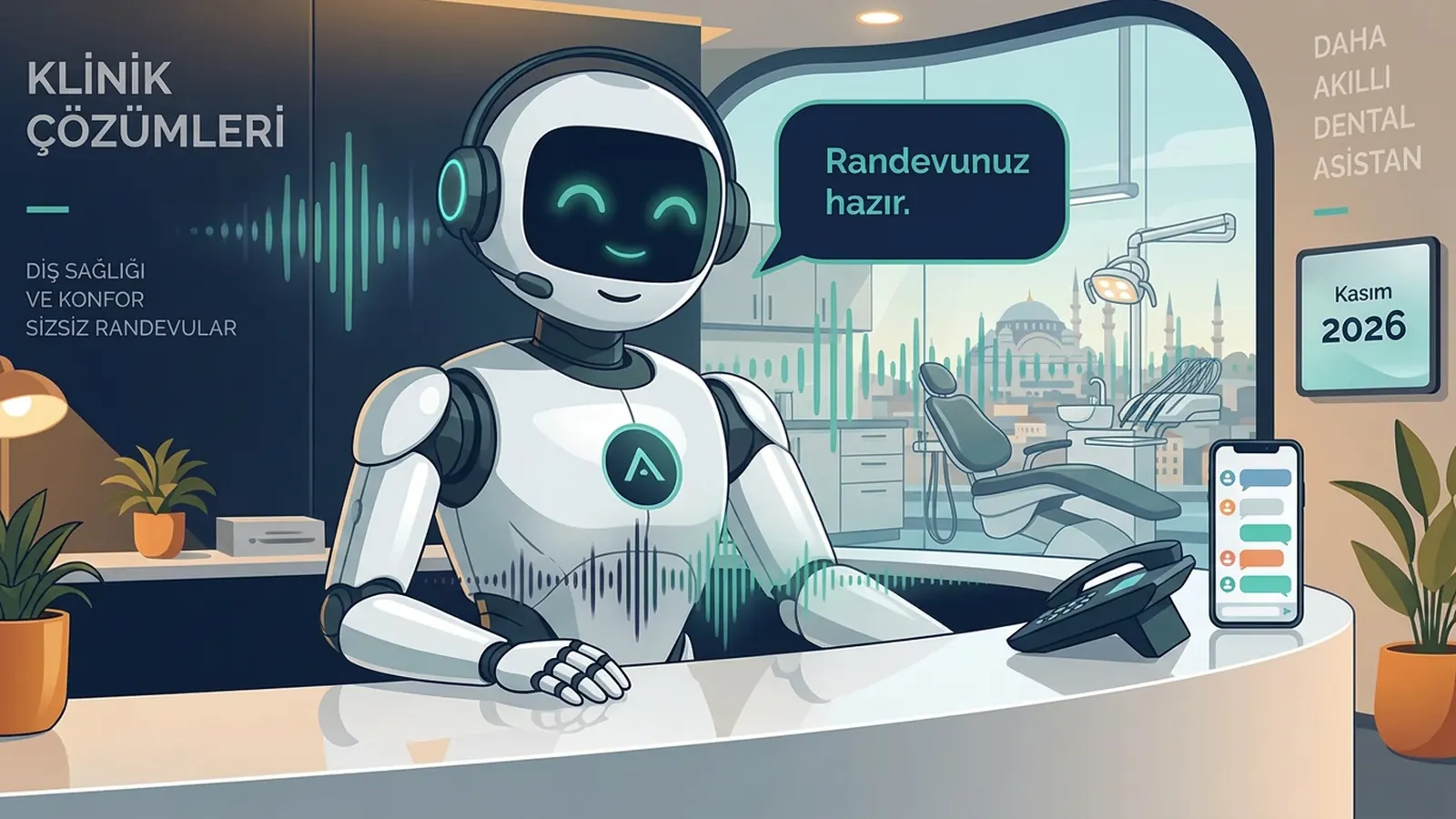
A dental clinic AI assistant is an AI assistant that answers your clinic’s phone and WhatsApp line 24/7, understands the patient’s need, creates appointment requests with the right dentist at a suitable time, sends reminders and passes pain or emergency cases to the team. In dental clinics the front desk does three things at once all day: looks after the patient in front of them, answers the phone and tries to keep up with WhatsApp messages. In the evening and at weekends the line is often silent — yet toothache does not keep office hours. In 2026–2027, this guide explains what a dental clinic AI assistant is, how it works on phone and WhatsApp, how it shares work with the front desk, treatment scenarios, setup, pricing logic and what to watch with health data.
Who is this guide for? People searching for a "dental clinic AI assistant" are mostly dentists who own clinics and clinic managers. They ask about more than a booking tool: who will answer phone and WhatsApp together, how the front desk’s load will drop, how several dentists’ calendars will be managed, how a patient in pain will be prioritised and how health data will be protected. Unlike our dental clinic AI appointment article, which focuses only on the booking flow, this guide covers the assistant’s whole communication role in the clinic.
What is a dental clinic AI assistant?
A dental clinic AI assistant is software that does the front desk’s routine phone and messaging tasks by talking and chatting. Patients do not press keys; they say "My filling came out, can you see me tomorrow?", and the assistant understands and offers a solution. Sesla, which runs on AI call centre infrastructure, delivers this on Türkiye’s most advanced AI call center infrastructure with your clinic’s name, your patient-greeting style and only information you have approved.
- Phone answering: picks up calls when the line is busy, at lunchtime, after hours and at weekends.
- WhatsApp replies: answers price, address, opening-hours and appointment messages with the same knowledge base.
- Appointment requests: takes the complaint, preferred dentist and time and places it in a free calendar slot.
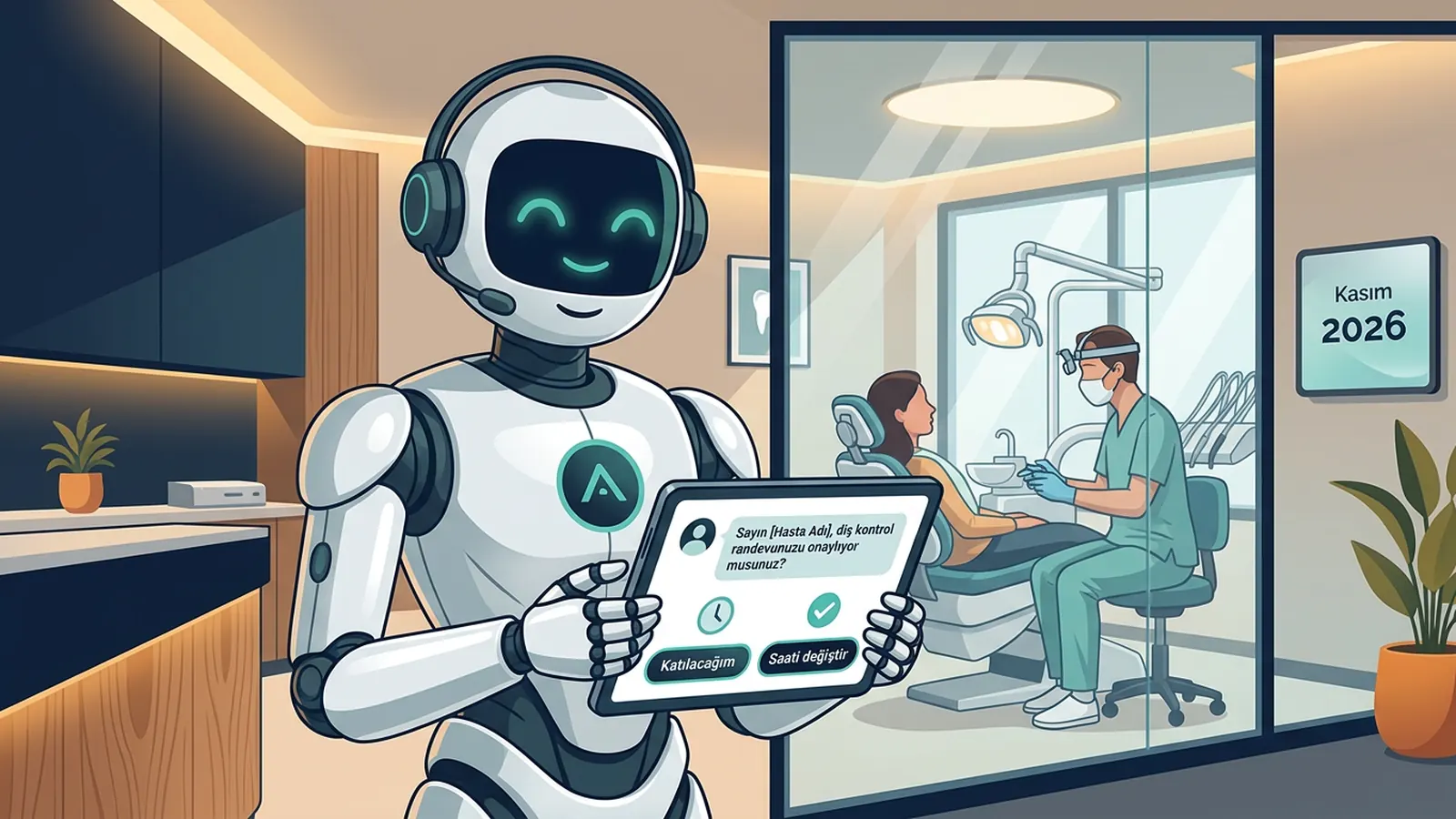
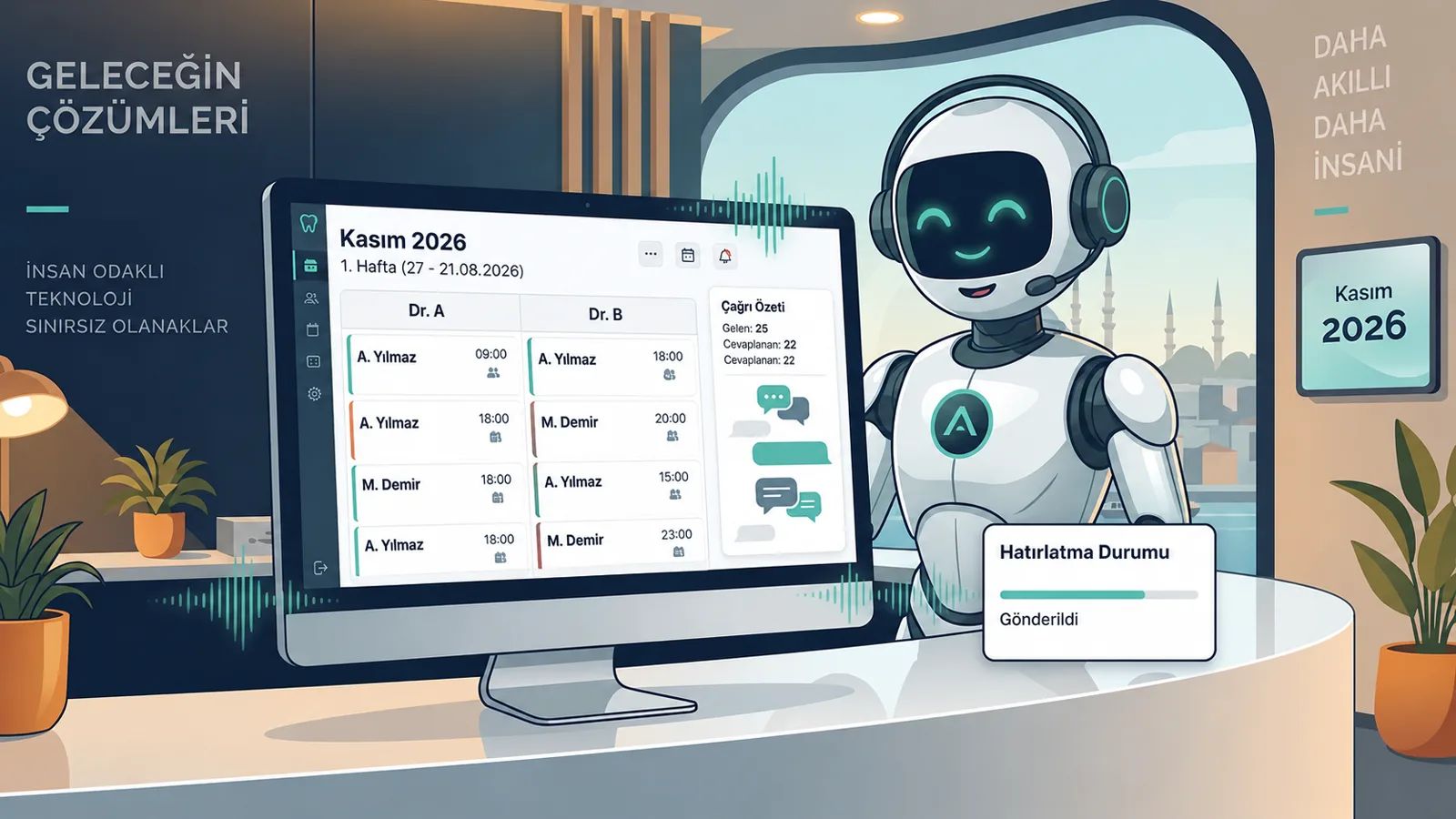
- Reminders and confirmation: sends a reminder before the appointment and records the patient’s attendance.
- Pre-information: notes whether it is a new patient, a check-up or interest in treatments such as implants or orthodontics.
- Emergency triage: passes swelling, severe pain or trauma to the team immediately according to your rules.
- Summary: puts a written summary and transcript of every conversation in the dashboard.
What the assistant does not do matters as much as what it does: it does not diagnose, recommend treatment or medication, or quote a firm price without an examination. These limits are defined in writing during setup, for patient safety and the clinic’s reputation.

How does a dental clinic AI assistant work on phone and WhatsApp?
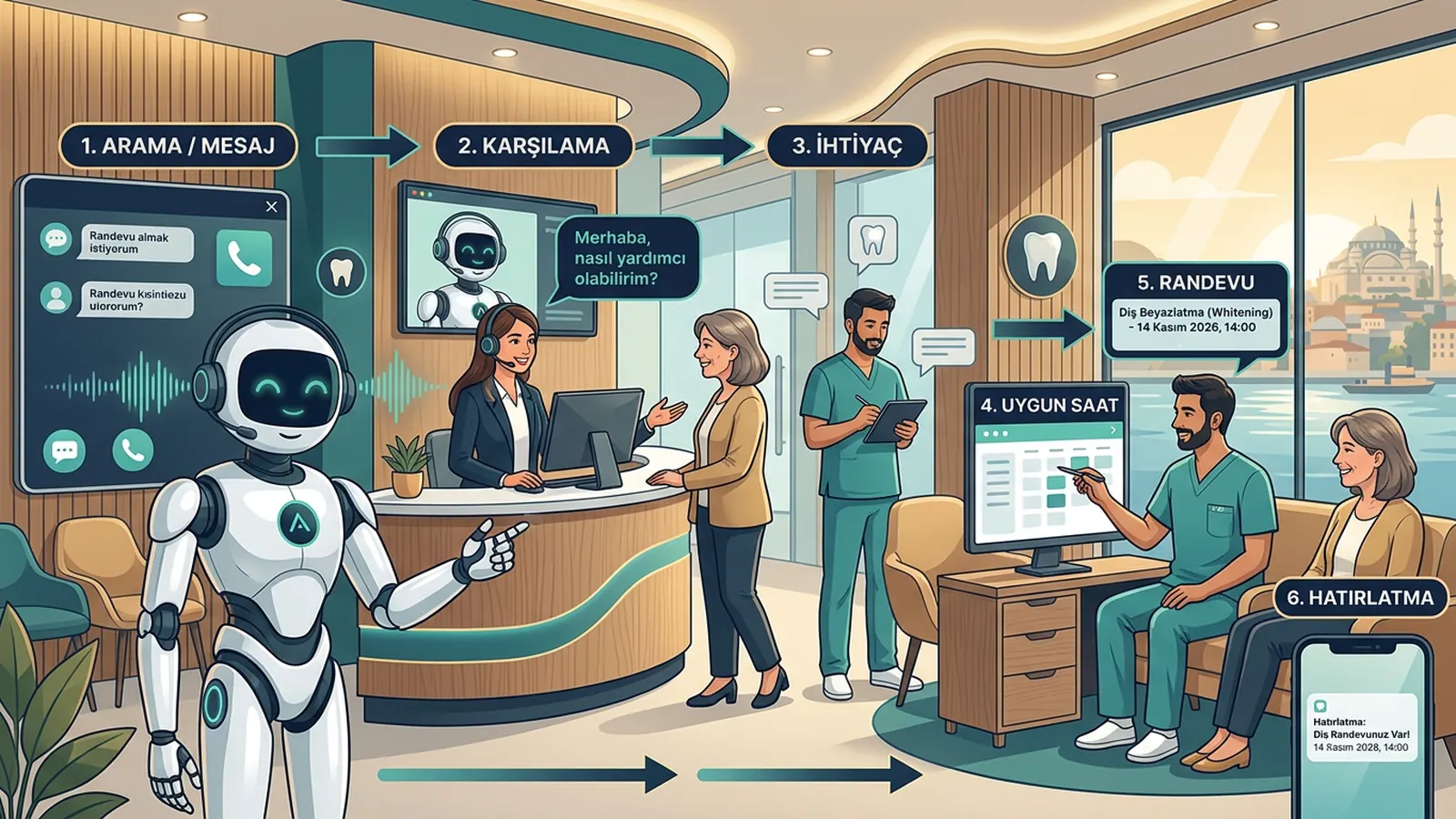
On the phone the assistant understands speech and replies in a natural voice; on WhatsApp it reads and answers text and voice messages. Both channels use the same knowledge base and the same calendar, so patients get the same correct information whichever channel they use. A patient’s journey looks like this:
- 1. First contact: the patient calls or writes on WhatsApp; call forwarding or the official WhatsApp infrastructure brings in the assistant.
- 2. Greeting: it opens transparently, e.g. "Hello, X Dental Clinic, I’m the clinic’s AI assistant."
- 3. Need: it asks about the complaint, new/existing patient status and preferred dentist.
- 4. Prioritisation: if there are urgent symptoms, the conversation goes to the person you defined; otherwise it moves to booking.
- 5. Suitable time: free calendar slots are offered and the patient chooses.
- 6. Appointment and reminder: the appointment request is created; a reminder and attendance confirmation are sent beforehand.
- 7. Summary: the conversation summary lands in the dashboard for the front desk and dentist.
The key point is that the assistant relies on understanding, not a script tree. A patient may say "I had a root canal last month and it’s aching again" and slip in "is there parking?". A well-configured assistant answers both, suggests a check-up and passes the note to the relevant dentist.
Front desk, classic booking system and dental clinic AI assistant compared
A dental clinic AI assistant does not remove the front desk; it shares the front desk’s phone and messaging load. Online booking forms only capture patients who fill them in. The table compares the three approaches.
| Criterion | Front desk only | Online booking form | Dental clinic AI assistant |
|---|---|---|---|
| Availability | Office hours | 24/7 but form only | 24/7 phone and WhatsApp |
| Simultaneous requests | One conversation | Unlimited forms | Several calls and messages |
| Answering questions | Yes | No | Yes, from the knowledge base |
| Emergency triage | Depends on experience | None | Transfer according to defined rules |
| Reminders and confirmation | Manual calls | Automatic email/SMS possible | Message reminders and attendance confirmation |
| Records and summary | Handwritten note | Form data | Transcript and written summary |
| Face-to-face relationship | Yes | No | No |
In short: the front desk is indispensable for relationships with patients in the clinic and for tasks like payments; a form only catches ready patients; an AI assistant provides continuous, consistent and recorded answering on phone and messaging. The best results come from a hybrid model where the assistant steps in when the front desk is busy and after hours.
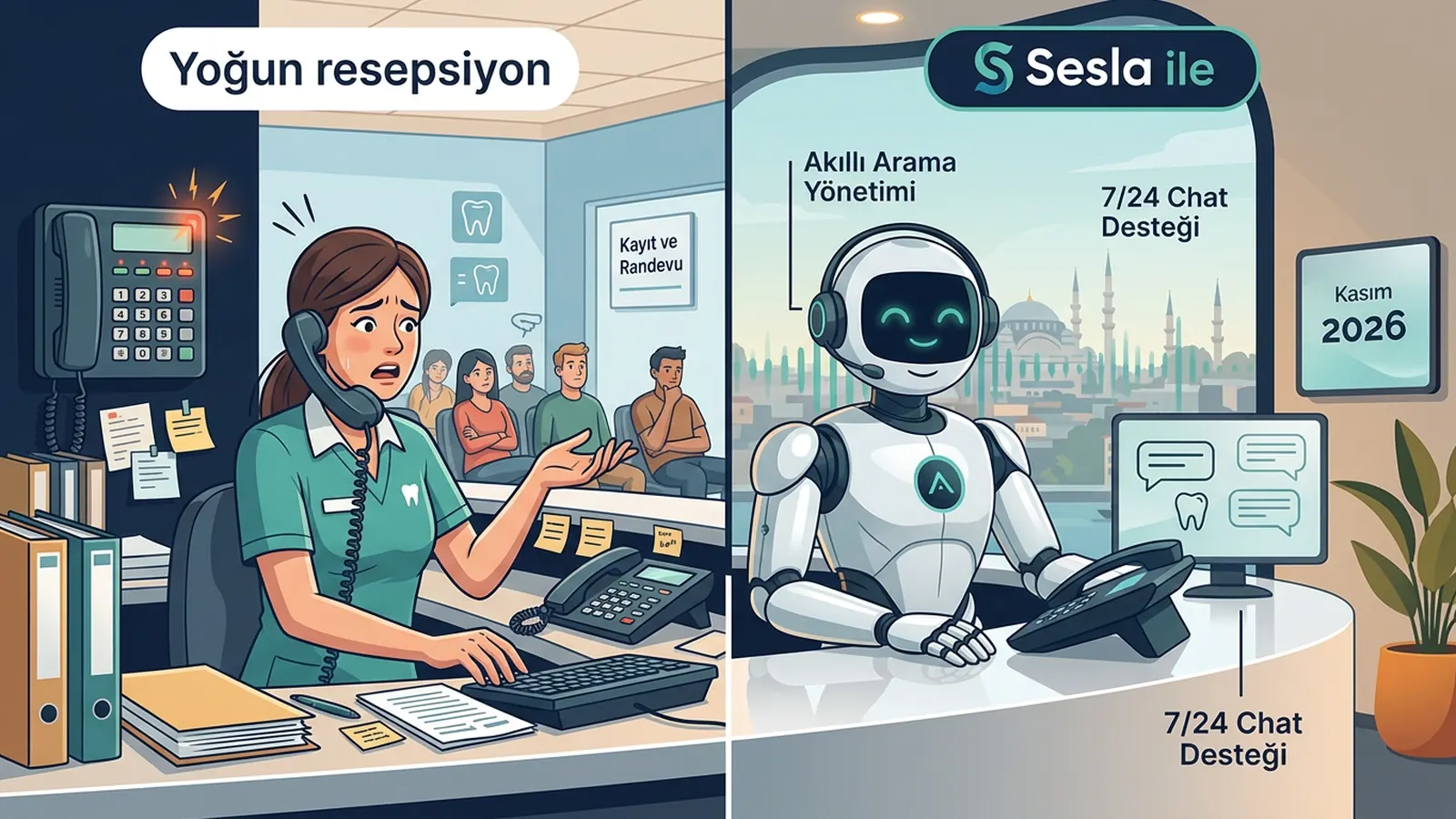
How do you divide work between the front desk and the assistant?
The easiest way to clarify the division of work is to split the day’s phone and message traffic into three groups. The first is routine requests: booking, changing a time, asking for the address and opening hours. These can be left to the assistant. The second is requests that need information gathering: interest in treatments such as implants or orthodontics, questions from foreign patients, insurance and partner-institution questions. The assistant collects the information and passes a summary to the front desk or coordinator. The third is matters that need a human decision: complaints, payments, treatment plan details and emergencies. These go straight to the team.
Once this split is in writing, the front desk can focus without interruption on the patient in the clinic. First thing in the morning they read the summary of calls and messages from the night; during the day they only take over conversations the assistant hands on. In the first weeks, noting which topics were handed over unnecessarily or which questions went unanswered and updating the knowledge base accordingly quickly fits the division of work to how the clinic really operates.
Use cases in dental clinics
The value of a dental clinic AI assistant shows up differently by treatment type. Here is a concrete scenario for each.
General examination and fillings
The most common request type. The assistant takes the complaint, offers free slots based on the patient’s preferred day and dentist and creates the appointment. For returning patients it can ask "has anything changed since your last visit?" and pass the note to the dentist.
Implant and prosthetics consultations
Patients ask about price first. The assistant gives information within the framework the clinic sets: it explains that the fee is determined by the dentist after examination and imaging, asks the patient to send any existing X-ray via WhatsApp and suggests a consultation.
Orthodontics and clear aligners
Long treatments involve regular check-ups. The assistant reminds patients of check-ups, offers a new time to those who want to change and helps reduce no-shows.
Paediatric dentistry
The caller is often a parent. The assistant takes the child’s age and complaint, offers free slots outside school hours and sends the appointment details to the parent’s number.
Acute pain and trauma
Symptoms such as swelling, severe pain, a broken tooth or bleeding are separated according to your rule. Without diagnosing, the assistant passes the case to the dentist on duty or the team and, if after hours, offers the first available emergency slot.
Foreign patients and medical tourism
Questions from abroad arrive at different hours and in different languages. The assistant collects initial details in the patient’s language, passes on X-ray or photo requests and prepares the file for the coordinator. For details see our medical tourism page.
You can see flows prepared for clinics on our dental clinics page and an overview for healthcare providers on our healthcare page.
A realistic conversation: a patient in pain calls the clinic
The example below is a call between a patient phoning a dental clinic in the evening and the Sesla assistant. Clinic and personal names are examples.
- Assistant: "Good evening, Gülüş Dental Clinic, I’m the clinic’s AI assistant. How can I help you?"
- Patient: "Hello, a tooth on my lower left has been hurting for two days. Could you see me tomorrow?"
- Assistant: "I’m sorry to hear that. Do you have any swelling in your face or a fever? I ask so I can pass you to our team straight away if needed."
- Patient: "No swelling, but it really hurts when I drink something cold."
- Assistant: "I understand. Have you been to our clinic before?"
- Patient: "Yes, Dr Elif did a filling for me last year."
- Assistant: "Dr Elif has free slots tomorrow at 09:30 and 14:15. Which suits you?"
- Patient: "09:30, please."
- Assistant: "May I have your first and last name?" — Patient: "Kerem Aydın."
- Assistant: "Mr Aydın, I’ve created your examination request with Dr Elif for tomorrow at 09:30. You’ll receive a WhatsApp reminder at this number; you can confirm attendance there or write that you’d like to change the time. I’ve passed this note on so our team can advise what to do if the pain gets worse tonight or swelling appears."
- Patient: "Thank you very much."
- Assistant: "You’re welcome, Mr Aydın. Get well soon, and have a good evening."
When the call ends, the clinic dashboard shows this summary: existing patient Kerem Aydın, sensitivity to cold in the lower left for two days, no swelling, tomorrow 09:30 Dr Elif, reminder scheduled. The assistant did not diagnose or recommend medication; it asked about symptoms, set the priority and started the process.
How do you set up a dental clinic AI assistant? 7 steps
Setting up a dental clinic AI assistant is complete once the knowledge base, dentist calendars and handover rules are prepared and the number is forwarded. The time depends on the number of dentists and the detail of the scenarios.
- 1. Define the scope: at what times and on which channels (phone, WhatsApp) will the assistant step in?
- 2. Knowledge base: services, dentists, opening hours, address and directions, FAQs and a "never say" list; the framework that can be shared on prices.
- 3. Calendar rules: per-dentist calendars, durations by procedure (examination, check-up, consultation), breaks and reserved slots.
- 4. Handover and emergency rules: who receives which symptoms, after-hours on-call details.
- 5. Voice and style: greeting line, form of address; optionally a clinic-specific voice through consented voice cloning.
- 6. Number and WhatsApp: connect the existing clinic number via forwarding, add WhatsApp through the official infrastructure and submit reminder templates for approval.
- 7. Test and monitor: have different team members make at least 20 test calls; read summaries daily for the first two weeks and update the knowledge base.
For WhatsApp infrastructure setup and Meta approval see our WhatsApp Business API guide. At Sesla you can share your needs on the design your assistant page and try the assistant on the phone in the live demo.
How is dental clinic AI assistant pricing determined?
Dental clinic AI assistant pricing is usually based on a monthly plan and conversation minutes; included minutes, number of channels and setup support affect the total cost. When comparing, look not only at the monthly fee but at the clinic’s real call and message volume.
| Item | Extra front-desk staff | AI assistant |
|---|---|---|
| Base cost | Salary and statutory obligations | Monthly plan |
| Hours covered | Office hours | 24/7 |
| Peak times | Extra person needed | Simultaneous answering, plan minutes |
| Same person’s time | Same knowledge base; Meta fees separate | |
| Leave and absence | Someone must cover | Not affected |
| In-clinic tasks | Included | Out of scope |
Ask these when getting a quote:
- How are extra minutes charged if included minutes are exceeded?
- Is there a setup fee, and is it different on an annual plan?
- Are Meta message fees for WhatsApp included? (At Sesla, Meta fees are not included in plans.)
- Do several dentist calendars cost extra?
- What are the contract term and cancellation terms?
For your own maths: count monthly missed calls and unanswered messages, estimate how many were new patients or treatment requests and multiply by the average treatment value. Sesla’s current plan prices are on the pricing page.
A 12-question checklist for choosing an AI assistant for a dental clinic
The most reliable way to choose the right assistant is to test it on phone and WhatsApp with your own clinic scenarios. Answer these questions during the trial:
- 1. Language quality: does it correctly understand patient names, phone numbers and treatment terms?
- 2. Latency: are replies fast enough not to break the conversation?
- 3. Emergency triage: does it transfer the call to the right person for the symptoms you defined?
- 4. Medical limits: does it avoid diagnosis, treatment or medication advice?
- 5. Dentist calendars: can it manage several dentists and different procedure durations?
- 6. Reminders: are there pre-appointment reminders and attendance confirmation?
- 7. WhatsApp: does it run on the official infrastructure, and does it understand voice messages?
- 8. Number: can you keep your existing clinic number?
- 9. Summary: is there a written summary and transcript of every conversation?
- 10. Data protection: are notice, access and retention rules for health data clear?
- 11. Languages: can it greet foreign patients in their own language?
- 12. Support and contract: are setup support, trial and cancellation terms clear?
Risks, medical limits, data protection and consent rules
In a dental clinic, the risks of an AI assistant mostly come from crossing the medical line, careless handling of sensitive data and unsolicited messages; they can be managed with the right rules.
- Medical decision limit: the assistant does not diagnose or recommend treatment or medication; it asks about symptoms, prioritises and refers to the dentist.
- Emergencies: the knowledge base should include a line directing patients to emergency services in life-threatening situations.
- Special category personal data: health information is special category data under KVKK (Turkey) and GDPR (EU); the privacy notice, cases requiring explicit consent, access rights and retention periods should be set with your legal adviser.
- Unnecessary data: only information needed for the appointment should be requested by phone or message.
- Call recording: if calls are recorded, callers must be informed at the start.
- Transparency: telling patients they are speaking with an AI assistant increases trust.
- Promotional messages: commercial electronic messages such as discounts or new-service announcements require the patient’s consent and, in Turkey, İYS registration; service notifications such as appointment reminders are assessed differently.
- Prices: no firm price should be given without an examination; the framework to be shared must be approved by the clinic.
A practical tip: before going live, write an "answer policy" together with your dentists. List separately the topics the assistant answers on its own, those it only notes and passes on, and those it does not discuss at all; have emergency wording approved by a dentist.
Why Sesla AI?
Sesla AI provides businesses with AI-powered customer communication on Türkiye’s most advanced AI call center infrastructure. It configures advanced voice and language models used at global scale for real clinic conversations and does the setup for you.
- An assistant that answers the clinic’s phone and WhatsApp line 24/7.
- One knowledge base for phone, WhatsApp, Instagram, Messenger and website chat.
- Appointments with Google Calendar and a written summary for every conversation.
- Handover to the team with a summary in the situations you define.
- Switch via forwarding without changing your existing number.
- Consented voice cloning and multilingual answering for foreign patients.
- A set-up that gives no medical diagnosis or advice and shares only clinic-approved information.
- Live demo before you buy.
For office phone answering see our AI secretary guide, and for the general picture of voice assistants our voice AI assistant guide.
We cover general patient reception, booking and reminder flows — from physiotherapy to eye and aesthetic clinics — in our clinic AI assistant guide.
Conclusion
A dental clinic AI assistant takes on the front desk’s heaviest load: phones ringing at the same time and WhatsApp messages piling up. Set up with the right knowledge base, per-dentist calendar rules, clear emergency handover rules and compliant data handling, it means patients are answered in the evening and at weekends, appointments land neatly in the calendar and reminders can help reduce no-shows. Dentists and the front desk can then spend their time on the patient in the chair.
To get started, count last month’s missed calls and unanswered messages, write down the 15 most common questions with your dentists and try the assistant with your own scenario in the live demo.
Frequently asked questions
How much does a dental clinic AI assistant cost?
Pricing is usually based on a monthly plan and included conversation minutes. Sesla’s current prices and scope are on the pricing page; Meta message fees for WhatsApp are separate.
Does the assistant diagnose or recommend treatment?
No. The assistant asks about symptoms, sets the priority and refers to the dentist; it gives no diagnosis, treatment or medication advice.
Do I need to change my clinic number?
No. Your existing number is connected via forwarding; you can choose forwarding when busy, when unanswered or always.
Can it manage several dentists’ calendars?
Yes. Per-dentist calendars and durations by procedure are defined; the assistant offers free slots based on the patient’s preferred dentist.
Does it also answer WhatsApp messages?
Yes. Through the official WhatsApp infrastructure it answers text and voice messages with the same knowledge base as the phone.
Does it send appointment reminders?
Yes. It sends a reminder before the appointment and lets the patient confirm attendance; patients wanting a new time are passed to the team or a rescheduling flow.
How does it separate patients in pain or emergencies?
Based on symptoms you define during setup (swelling, severe pain, trauma and so on), it transfers the conversation to the dentist on duty or the team, or offers the first available emergency slot.
Is patient data processed in line with data protection law?
Compliance comes from the setup: patients are informed, only necessary data is collected and access rights and retention periods are defined. Since health data is special category data, clarify the rules with your legal adviser.
Can it talk to foreign patients?
Yes. It can greet patients in languages such as English and German as well as Turkish, and sends the summary to your team in Turkish.
Describe your needs in 3 minutes and we prepare your assistant draft and quote.