
AI phone receptionist for law firms: no client lost during hearings
People seeking legal help go with the first firm that answers. An AI receptionist collects intake details and books consultations without giving advice.
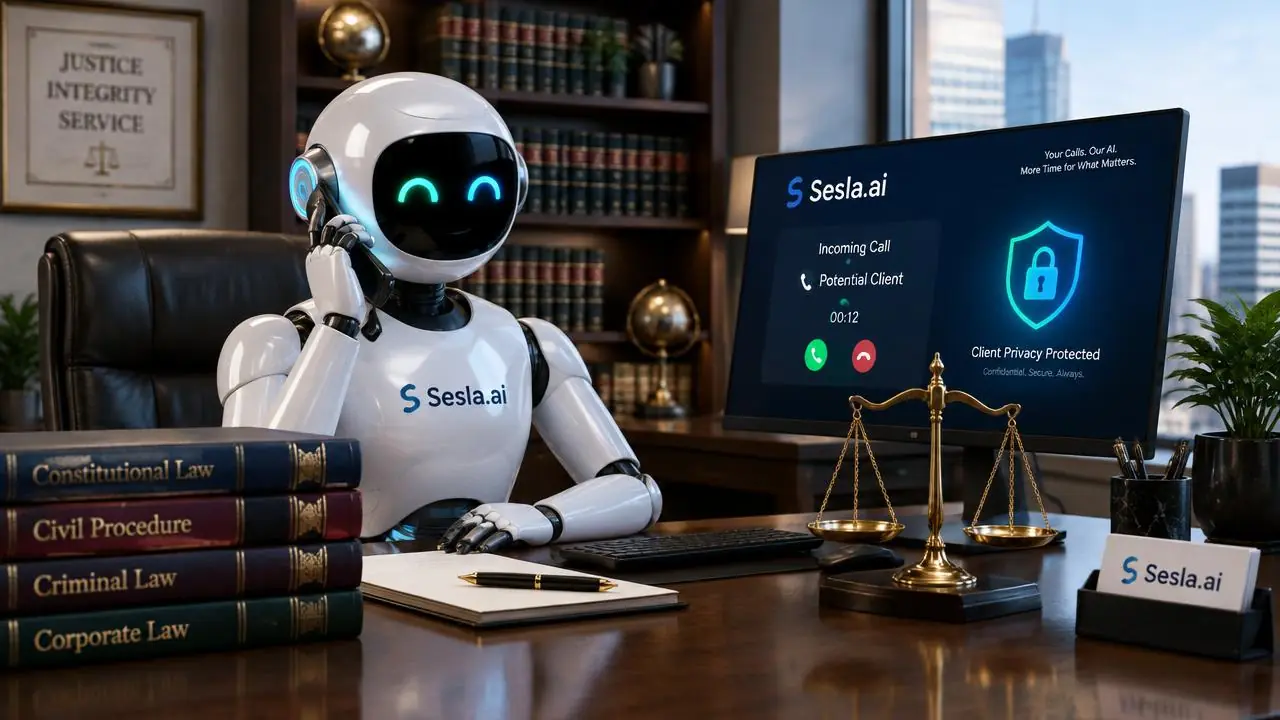
A person seeking legal support is often stressed, hurried, and quick to make decisions. In matters such as divorce, workplace accidents, rental disputes, or criminal investigations, they tend to trust the first firm they reach out to and who listens to them. However, a lawyer cannot answer the phone while in court, meeting with a client, or drafting a petition. In this guide, we explain in detail why law firms miss potential clients, how an AI phone assistant fills this gap without providing legal advice, and address confidentiality and GDPR/KVKK issues, as well as the setup steps with Sesla.
Why do law firms miss potential clients?
Due to the nature of the legal profession, a lawyer's day is often spent outside the office. Morning court hearings, afternoon visits to enforcement offices or expert inspections, evening client meetings… In small and medium-sized firms, the secretary is often simultaneously dealing with file tracking, notifications, and collections. The phone call becomes the easiest task to postpone amidst this intensity.
The problem is that a person seeking legal support doesn't wait. They call the first three firms they find online and schedule an initial consultation with the first one to answer. When called back, they have often already engaged another lawyer. This loss is even more pronounced in areas like labor law, family law, and criminal law, where time is critical.
The cost to a firm of a missed call
The value of a single case in a law firm is quite high, considering the attorney's fee and the duration of the case. A divorce case, a labor claim, or a consultancy agreement with a company can generate a revenue stream lasting months or even years. Therefore, even a single missed call can make a difference in a firm's annual income.
| Item | Solo Law Practice | Mid-sized Firm | Large Firm |
|---|---|---|---|
| Monthly new calls | 120 | 350 | 900 |
| Unanswered rate | %35 | %25 | %15 |
| Missed calls | 42 | 88 | 135 |
| Conversion to initial consultation | %30 | %30 | %30 |
| Lost initial consultations | 13 | 26 | 40 |
| Conversion to case rate | %35 | %35 | %35 |
There is also a reputation dimension to the cost. A firm whose phone calls go unanswered is coded in the potential client's mind as an "unavailable lawyer." In legal processes, accessibility is the foundation of trust; this experience during the first contact affects the entire subsequent relationship.
Legal boundaries: what the assistant does, what it doesn't do
The most critical issue when using AI in law is that the assistant does not provide legal advice. Sesla does not use phrases like "you will win your case," "you will receive this much compensation," or "you should do this." Its role is an administrative front office task: to listen, accurately gather information, schedule appointments, and transmit complete details to the lawyer.
- Does: notes the subject and stage of the dispute in the person's own words.
- Does: facilitates conflict of interest checks by obtaining the opposing party's name.
- Does: schedules initial consultation appointments, provides address and consultation fee information.
- Does not: provide legal advice, outcome predictions, timeframes, or compensation promises.
- Transfers: emergency situations like arrests, detentions, or cases with impending notification deadlines immediately to the lawyer according to your defined rules.
These boundaries are important not only ethically but also in terms of professional rules. Within the framework of the attorney advertising ban and professional rules, the language used by the assistant is designed to be plain, informative, and non-promising. These communication rules are determined together with your firm during Sesla setup.
The Sesla difference: why is it suitable for law firms?
Sesla speaks in your firm's name, with a serious and trustworthy tone. It asks callers questions in a calm sequence, does not rush them, and transforms what they say into a structured initial consultation note. Our AI solution for law firms is customized according to your areas of practice, number of lawyers, and consultation arrangement.
| Criterion | Firm Secretary | Answering Machine | Virtual Secretary Service | Sesla |
|---|---|---|---|---|
| After-hours | None | Recording | Limited | 24/7 |
| Structured pre-information | Person-dependent | None | Partially | Same form for every call |
| Conflict of interest information | Sometimes | None | Sometimes | Opposing party always asked |
| Initial consultation appointment | Yes | No | Yes | Yes |
| Privacy Control | In-house | — | Third-party | Access permissions in-house |
| Cost | Fixed salary | Very low | Monthly + per call | Transparent package |
Another advantage of Sesla for law firms is the initial contact with foreign clients. Foreign nationals, companies, or citizens living abroad are greeted in languages such as English, German, or Arabic; their requests are fully recorded and forwarded to the relevant attorney.
Ideal initial consultation information set
A good initial consultation note enables the attorney to be prepared for the first meeting and prevents the prospective client from repeating the same information. However, asking for too much information is both risky under GDPR/KVKK and tiresome for the caller. Therefore, the information set should be kept brief and goal-oriented.
- Name, surname, and contact information.
- Subject of the dispute (e.g., labor receivables, divorce, rent, enforcement).
- Stage of the process: has a lawsuit been filed, has a summons been received, is there a deadline?
- Name or title of the opposing party (for conflict of interest check).
- Preferred meeting method and time: in-person, phone, or online.
The AI assistant does not ask for detailed sensitive personal data such as health information or criminal records; if the person shares it themselves, the AI assistant only notes the topic and states that details will be discussed during the meeting with the attorney. This approach both protects privacy and limits the firm's data responsibility.

Privacy and GDPR/KVKK
In law firms, privacy is the essence of the profession. During Sesla setup, what data will be collected, who will access this data, how long it will be stored, and how the data processing consent text will be presented are determined together with your firm. A brief data processing consent statement at the beginning of the call and a referral to the detailed text are added to the flow.
Access permissions are under your firm's control: it can be defined which attorney can see which initial consultation notes. Whether call recordings are kept and their retention period are also set according to the firm's preference. This structure provides a more controlled environment compared to a third party listening to client information, as in virtual secretarial services.
Step-by-step in-firm setup
- 1. Define your practice areas and the types of cases you accept.
- 2. Determine the initial consultation information set and communication guidelines.
- 3. Add attorneys' initial consultation schedules and consultation fee information.
- 4. Write down emergency transfer rules: detention, time-sensitive matters, summons.
- 5. Start with after-hours and busy call handling, evaluate notes from the first few weeks.

Pricing
Call volume in law firms is generally moderate, but call durations may be slightly longer compared to other sectors. Therefore, when choosing a package, it is necessary to consider the average call duration in addition to the monthly call count. The table below shows the current Sesla packages.
| Plan | Monthly | Annual (per month) | Included minutes | Extra minute | Setup on annual |
|---|---|---|---|---|---|
| Starter Plan | $59.99 | $44.99 | 120 min | $0.25 | Paid |
| Professional Plan | $129.99 | $97.49 | 300 min | $0.23 | Paid |
| Enterprise Plan | $259.99 | $194.99 | 600 min | $0.22 | Free |
| Premium Plan | $519.99 | $389.99 | 1,200 min | $0.15 | Free |
Even one new case per month can cover the annual subscription fee for most firms. To make a comparative calculation with the cost of a secretary, you can use the calculator on our pricing page.
Initial consultation flow by practice area
Each area of law generates different information needs. For labor law calls, the date of termination, duration of employment, and whether the mediation process has started are important. In family law, the status of the parties, the presence of children, and the need for immediate protection are prominent. In commercial law, the company title, the amount of the dispute, and the contract type are decisive. The AI assistant using a separate and concise question set for each area improves the quality of the initial consultation note.
Calls received in areas where the firm does not practice are also important. The AI assistant politely states that the firm does not provide services in that area and informs the person according to the firm's preference. This approach prevents the attorney from wasting time on unsuitable initial consultations and saves time for the caller.
In firms that handle a high volume of collections and enforcement proceedings, a significant portion of calls relate to existing cases. Debtors ask about payment plans, and clients inquire about the status of their case. The AI assistant distinguishes these calls, records the case number and request, and forwards them to the relevant attorney or firm employee. This way, new client calls and existing case calls do not get mixed up.

Communication with existing clients
A significant portion of phone traffic in law firms comes from existing clients: when is the court date, has the petition been filed, has the opposing party's response arrived? Each of these questions takes up the attorney's or secretary's time. After verifying the client's identity, the AI assistant can provide general information that the firm permits to share or note the request and forward it to the relevant person.
At this point, privacy rules are especially important. For most firms, the safest approach is for the AI assistant not to share case details, but only to manage administrative information such as appointments and callbacks. Which information can be shared is at the firm's discretion and is clearly defined during setup.
Regularly providing attorneys with a list of callback requests from existing clients also increases client satisfaction. The client knows that they were heard and their request was recorded when they called; the attorney, in turn, clearly sees whom they need to call back at the end of the day.

30-day roadmap for firms
In the first week, the AI assistant only handles calls received after hours and during court sessions. Attorneys review the initial consultation notes every evening and evaluate whether the question set is sufficient. In the second week, question sets are differentiated by practice area, and informative statements are added for areas the firm does not serve. In the third week, identity verification and callback flow for existing client calls are activated.
In the fourth week, initial results are measured: the number of new calls handled by the AI assistant, the initial consultation appointments created, and how many of these converted into mandates. This data also shows which areas the firm receives demand for and where marketing efforts should be directed.
Attorneys' routine working with the AI assistant
On court days, attorneys can mute their phones and focus entirely on their cases. At the end of the day, the summary list sent by the AI assistant shows who called, what help they requested, and when they want to meet. Urgent situations are conveyed instantly according to the defined rule, so no critical development is missed.
- Morning: Review initial consultation notes received overnight.
- During court breaks: Check urgent notifications.
- Evening: Complete the callback list, confirm appointments.
- Monthly: Evaluate the area-based demand report.
Example return on investment scenario
Suppose a single-attorney firm receives 100 new calls per month and misses one-third of them due to heavy court schedules. If even a few of the missed calls turn into initial consultations, and some of those into mandates, the firm gains new cases every month. Since the retainer fee for a single case often covers the AI assistant's annual cost, the return on investment is quickly realized.
In addition, the attorney's time is a significant gain. The reduction of minutes spent on phone calls during the day, which can break focus, increases the time available for preparing petitions and cases. This positively impacts both the quality of work and the attorney's work-life balance.
Common mistakes made by law firms
The first mistake is to make the initial consultation question set too detailed. Subjecting the caller to a long interrogation on the phone both tires them out and leads to the collection of more personal data than necessary. The information required for an attorney to prepare for the first meeting can usually be obtained with five or six questions; the remaining details are discussed in a face-to-face meeting.
The second mistake is to leave the initial consultation fee and process vague. Callers want to know if the first meeting is paid, how long it will last, and what they need to bring. Clearly sharing this information through the AI assistant reduces the no-show rate for appointments and establishes a transparent relationship between the firm and the prospective client from the outset.
The third mistake is not aligning the language used by the AI assistant with professional rules. The AI assistant should not use phrases like "best lawyer," "definite results," or "guaranteed," but rather speak in a plain and informative manner. These communication guidelines are determined with the firm during setup and applied in all the AI assistant's conversations.
The fourth mistake is not regularly following up on initial consultation notes. The AI assistant schedules the appointment; however, the attorney or firm employee needs to confirm the appointment and, if necessary, request documents from the prospective client for preparation. Integrating notes into the daily routine ensures that the opportunities gained by the AI assistant truly convert into cases.
Checklist for law firms
- Practice areas and accepted case types.
- Area-based short initial consultation question sets.
- Initial consultation fee, duration, and meeting methods.
- Attorneys' initial consultation schedules.
- Emergency definitions and transfer numbers.
- Communication guidelines and forbidden words.
- Identity verification step for existing client calls.
- GDPR/KVKK data processing consent text and access permissions.
A firm day with the AI assistant
09:30 AM. While the attorney is in court, a person who says they were laid off calls. The AI assistant answers the phone in the firm's name, asks for the termination date, duration of employment, and whether the mediation process has started. It notes the opposing party's company name and creates an initial consultation appointment for the next day. When the attorney leaves court, the initial consultation note is ready on their phone.
03:00 PM. An existing client calls to inquire about the latest status of their case. The AI assistant verifies the client's identity, notes the request, and states that the attorney will call back at the end of the day. The client, knowing their request has been recorded, does not call repeatedly.
11:10 PM. A person calls saying their relative has been detained. The AI assistant recognizes this situation according to the firm's defined emergency rule, gathers basic information, and transfers the call to the on-call attorney's number. An urgent legal need reaches the right person, even outside of business hours, without being missed.
Measuring success in law firms
Four metrics are sufficient to measure the impact of an AI assistant in law firms: new call answer rate, initial consultation conversion rate, initial consultation to mandate conversion rate, and the number of requests captured after hours. Comparing these four metrics to the three months before the AI assistant clearly shows what the investment has brought to the firm. Sesla's reporting screen provides this data without you needing to keep separate tables.
In addition to these metrics, area-based demand distribution is also valuable information for the firm. Seeing how much demand comes from which area of law allows the firm to base its specialization and marketing decisions on data. For example, a firm realizing that labor law requests are higher than expected might decide to produce content in this area or assign additional attorneys.
Finally, client feedback should also be considered. Clients who experience a quick and organized first contact tend to find the firm more professional and are more likely to recommend it to others. Considering the importance of recommendations in legal services, this indirect effect significantly contributes to the firm's long-term growth.
Key takeaways
- Individuals seeking legal assistance tend to proceed with the first firm they reach; response speed is critically important.
- The AI assistant does not provide legal opinions; it collects information, schedules appointments, and transfers them to the attorney.
- Obtaining the opposing party's name at the outset facilitates conflict of interest checks.
- Privacy, access permissions, and GDPR/KVKK data processing consent are integral parts of the setup.
- Starting small and expanding the scope with the first month's data is the healthiest approach.
These principles make the firm's first contact experience professional and trustworthy. While the attorney dedicates their time to cases, the firm never silently loses any prospective client, and every request is regularly recorded.
As your firm's needs change, question sets, transfer rules, and calendar settings can be easily updated; the AI assistant grows with your firm.
Conclusion
In law firms, trust begins with the first phone call. An AI phone assistant does not replace the attorney; it keeps the firm's doors open while the attorney is in court, listens to the prospective client, and delivers a ready initial consultation note to the attorney. With Sesla, your firm offers an accessible, organized, and professional first contact experience. If you'd like to hear the AI assistant's speaking style first, you can try the live demo on our homepage.
Frequently asked questions
Does an AI phone assistant provide legal advice?
No. The assistant does not provide legal advice, does not promise outcomes or compensation; it only gathers information and schedules initial consultation appointments.
How does it help with conflict of interest checks?
In every initial consultation, the name or title of the opposing party is requested and added to the notes; this allows the firm to perform a check before the consultation.
What happens in emergencies?
Situations such as arrests, detentions, or cases with impending deadlines are immediately transferred to a lawyer according to the rules set by the firm.
Will client information remain confidential?
Access permissions and retention periods are determined by the firm; the GDPR/KVKK disclosure flow is included in the conversation.
Does it conflict with the attorney advertising ban?
The assistant's language is designed to be plain, informative, and non-promising; communication rules are determined together with the firm.
Can it speak with foreign clients?
Yes. It can handle first contact in English, German, Arabic, and many other languages.
Can it state the initial consultation fee?
Yes, it can share the initial consultation fee and payment information as determined by the firm.
Do we need to change our number?
No. Busy, unanswered, and after-hours calls are transferred to Sesla via forwarding.
How long does setup take?
If workspaces and calendar information are ready, it can go live within a few days. Expert setup is free for Annual Corporate and Premium packages.
Are conversations recorded?
Whether or not recordings are kept, and their retention period, is set according to the firm's preference.
Is it suitable for a solo law practice?
Yes. Solo law practices constitute the group that benefits most during court hearings and hours spent outside the office.
Describe your needs in 3 minutes and we prepare your assistant draft and quote.