AI Call Analytics 2026–2027: Transcripts, Summaries, Quality Scoring and Reporting
Call analytics makes every call measurable with transcripts, summaries, topic and outcome tags. 10 metrics, quality scoring and a weekly report template.
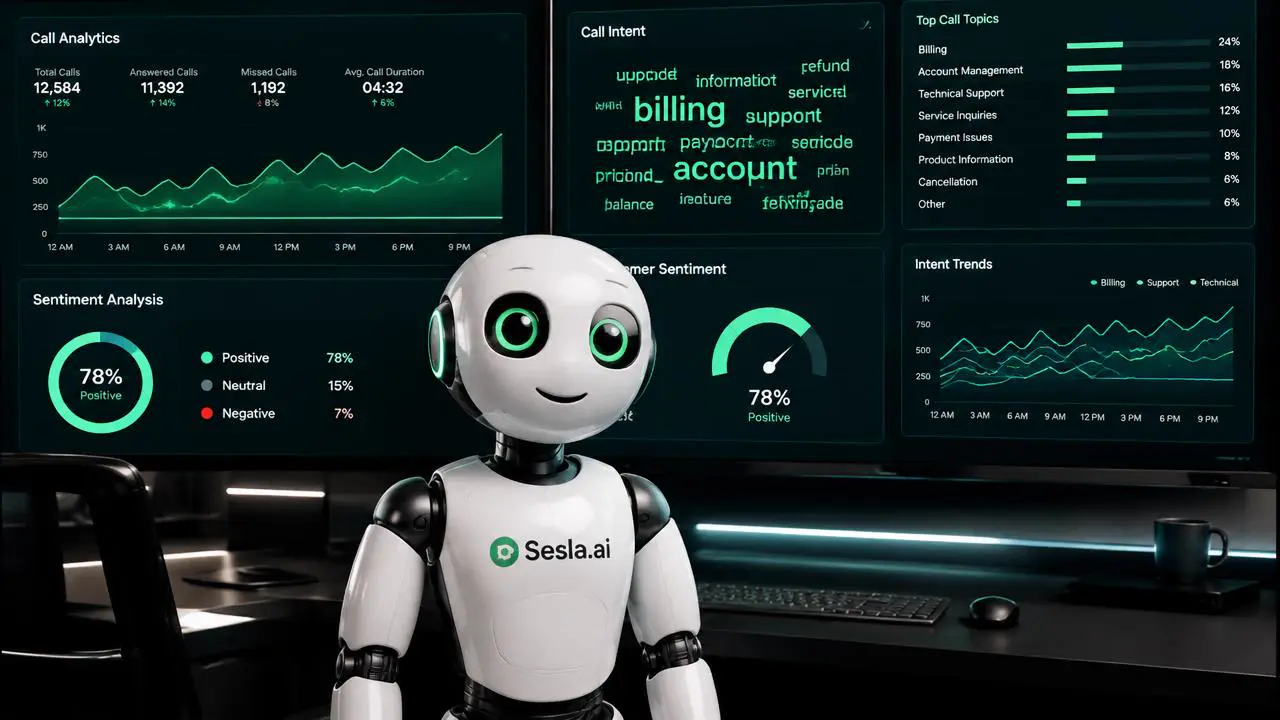
Every phone call is a source of data on what customers really want. Price objections, most-requested services, complaint reasons, competitor names, requests that never became bookings… For years most of this was lost in audio recordings, because no team could listen to and analyse thousands of calls. In 2026–2027, AI call analytics has become a management tool that automatically transcribes, summarises and classifies every call and turns it into measurable insight. This guide explains what call analytics is, which metrics to track, how quality scoring works and how to turn analytics into revenue and efficiency.
What is AI call analytics?
Call analytics used to mean phone-system statistics: call counts, average duration and missed-call rate. With AI, the content of a conversation becomes measurable too: what was said, what the customer wanted, how they felt and what the outcome was. Sesla AI brings each call’s recording, transcript, summary and outcome tag together in one dashboard on Türkiye’s most advanced AI call center infrastructure.
| Topic | Classic phone report | AI call analytics |
|---|---|---|
| Measures | Counts, duration, missed | Content, intent, sentiment, outcome |
| Call content | Audio (rarely heard) | Transcript and summary (read, searched) |
| Topic analysis | None | Automatic topic tags |
| Quality review | Random listening | Criteria-based across all calls |
| Insight | Manager’s guess | Data-driven trends |
| Action | Delayed | Weekly or even daily |
The 5 building blocks of call analytics
1. Transcript
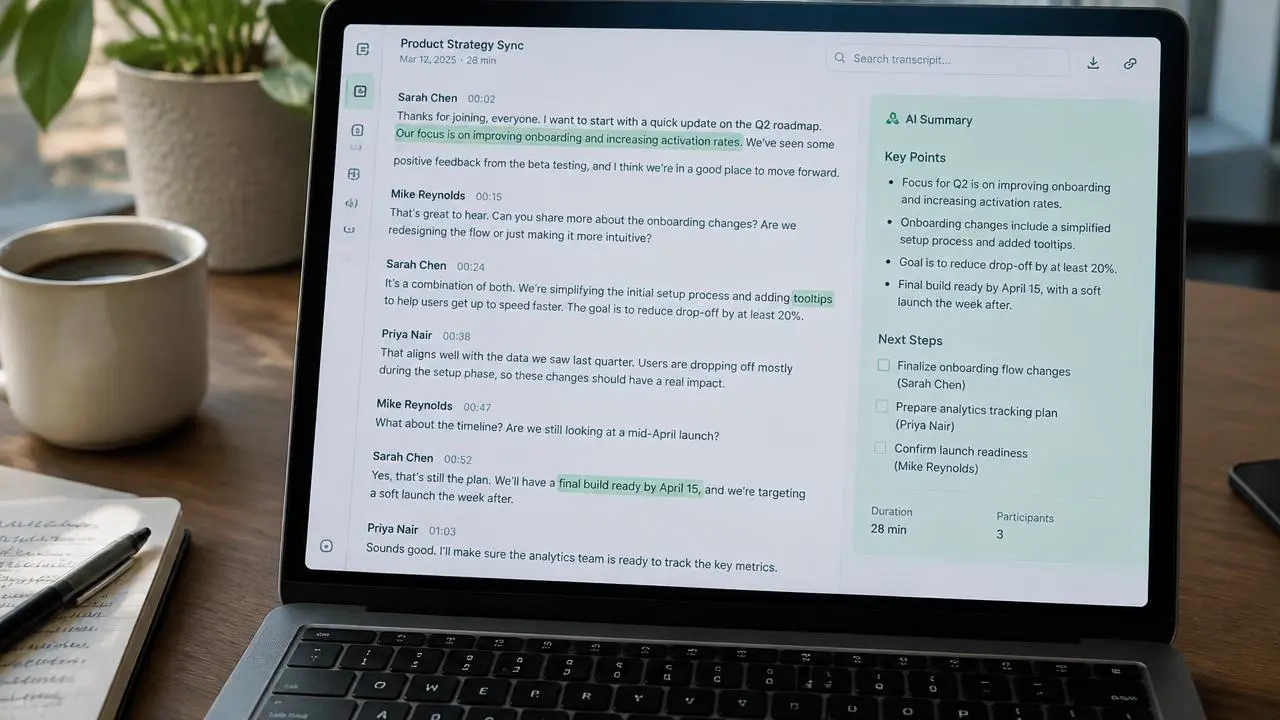
Every call is transcribed with speakers separated. Text is far faster to read than audio, searchable and the basis for all other analysis.
2. Summary
AI turns each call into a few-sentence summary: request, information given, action taken and next step. Managers can see the essence of hundreds of calls in minutes.
3. Topic and intent tags
Calls are automatically sorted into topics such as “pricing question”, “booking”, “complaint”, “return” or “technical issue”. Seeing how often each topic comes in and how it changes is the basis of operations and marketing decisions.
4. Outcome tags
Every call’s outcome is marked: booking created, information given, transferred, callback requested, unresolved. These tags are the clearest way to measure conversion and the real impact of automation.
5. Sentiment and satisfaction signals
Positive and negative phrases, raised voices or repeated complaint patterns are flagged as satisfaction signals. They are not a definitive score but an alert system that highlights calls needing attention.
10 call metrics to track
- Total volume and channel mix: requests from phone, WhatsApp and web chat.
- Answer rate: share of calls answered on the first attempt.
- Missed calls: unanswered calls and their time distribution.
- Resolution rate: requests completed without human intervention.
- Transfer rate and reasons: which topics go to people.
- Conversion rate: calls that become bookings, orders or quotes.
- Average handling time: by topic; long calls reveal process issues.
- Topic distribution: top 10 topics and how they change.
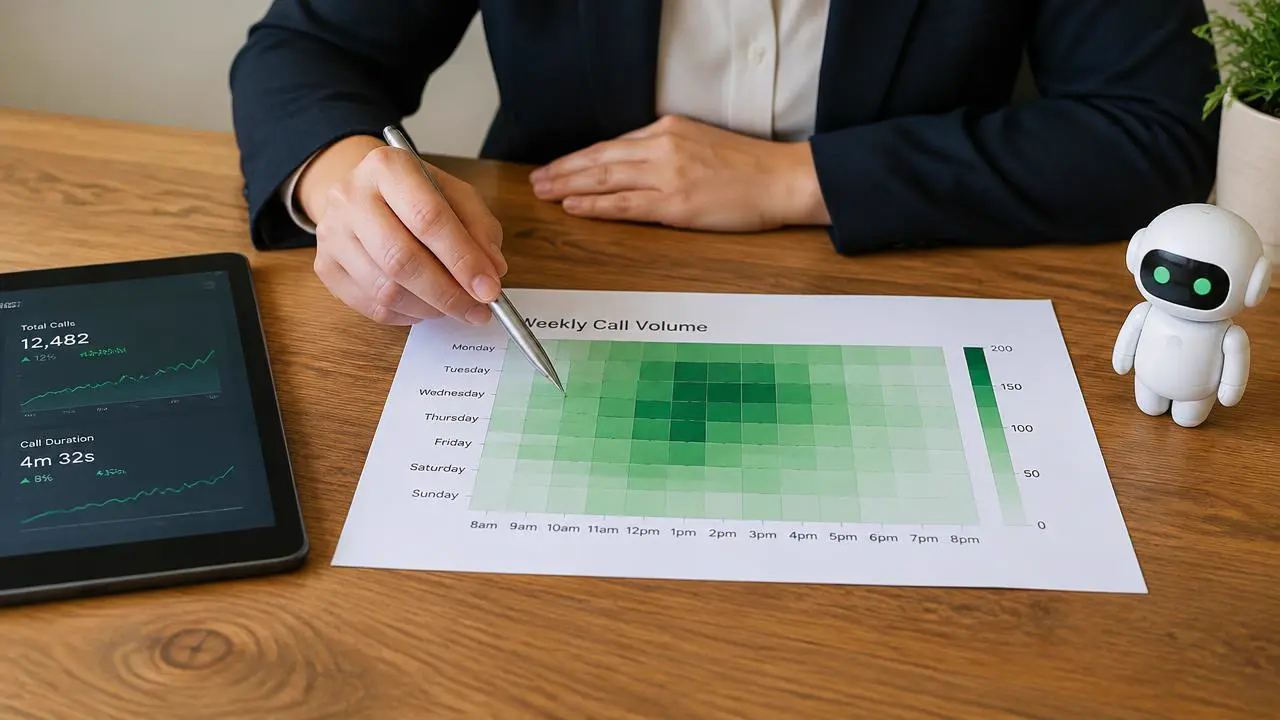
- Hourly/daily load: the basis for staffing and capacity planning.
- Satisfaction signals: share of negatively flagged calls and common causes.
Quality scoring: rating every call against the same criteria
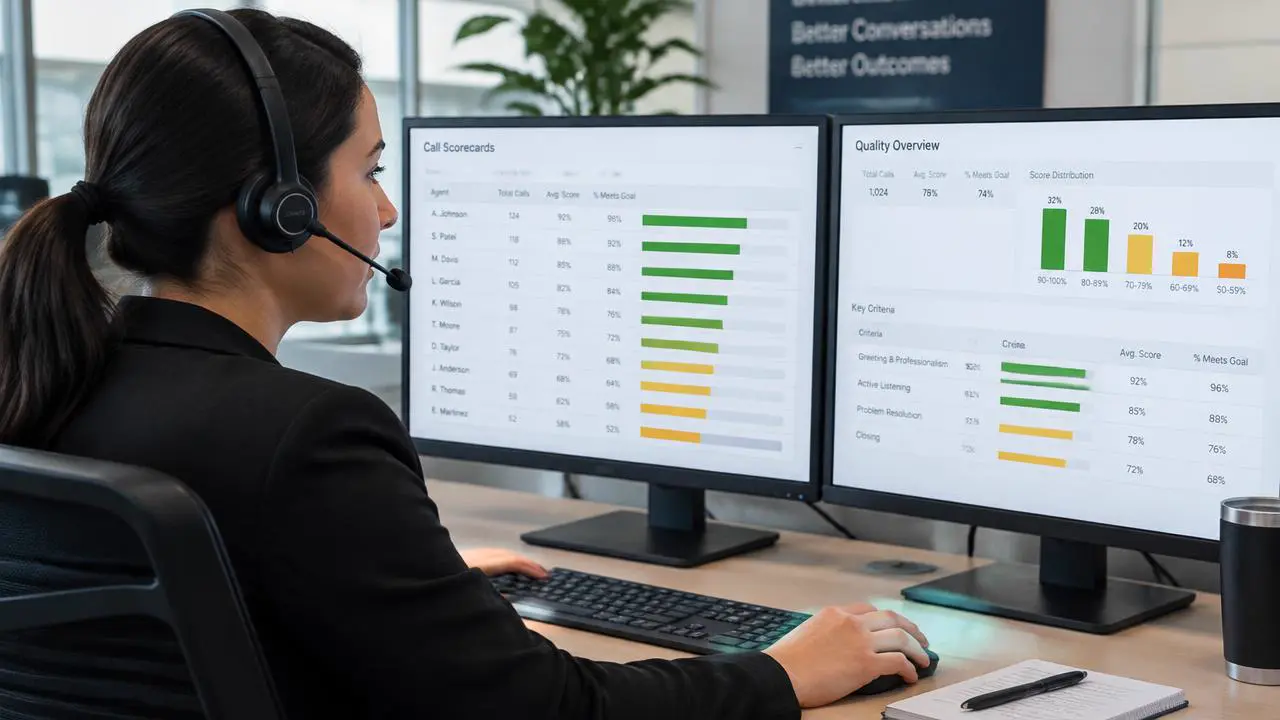
In traditional call centers a quality team listens to a tiny random sample of calls. It is slow and not very representative. AI-assisted quality scoring rates every call against the same criteria and surfaces those needing attention.
| Criterion | What is measured | Example |
|---|---|---|
| Greeting | Business name, AI disclosure, offer to help | “Hello, welcome to X…” |
| Correct information | Match with the knowledge base | Accurate prices and hours |
| Understanding the need | Correct identification of the request | Right topic tag |
| Resolution | Request brought to an outcome | Booking created |
| Handover quality | Transfer with a summary to the right person | Customer did not repeat themselves |
| Closing | Recap and polite close | “Your appointment is tomorrow at 2 pm…” |
Both the AI assistant’s and human agents’ calls can be scored with the same criteria, revealing training needs, knowledge gaps and process problems objectively.
From analytics to insight: 6 practical uses
- Improve the knowledge base: the most-transferred topics show what to add.
- Pricing and offer strategy: frequency and reasons of price objections feed pricing decisions.
- Capacity planning: hourly load supports shift and opening-hour decisions with data.
- Marketing messages: customers’ own words are the best source for ad and website copy.
- Product and service development: recurring complaints and requests set improvement priorities.
- Loss reasons: why calls did not become bookings or sales improves the sales process.

See our reporting feature for details, and our call center automation solution for high-volume teams.
Weekly report template: a 30-minute management meeting
Analytics only pays off when it is read regularly. This weekly template works from a small business to a large call center and can be read in half an hour.
- 1. Volume: how many requests this week, channel mix, change vs last week.
- 2. Reach: how many calls were missed and when.
- 3. Outcomes: resolution, transfer and conversion rates.
- 4. Topics: top 5 and rising/falling topics.
- 5. Signals: negatively flagged calls and common causes.
- 6. Actions: knowledge base additions, process changes, owners.
Data security, privacy and retention
Because call analytics works with recordings containing personal data, security and compliance are part of setup. Recording must be disclosed in a privacy notice, access limited by role, retention periods defined and data deleted when they expire. The scope of analysing sensitive data (such as health information) must be assessed separately under the applicable law (e.g. GDPR or KVKK).

See our security page and privacy policy for Sesla’s approach.
Cost and return of call analytics
At Sesla, transcripts, summaries and outcome tags are a standard part of every call the AI handles; no separate analytics tool is needed. The return is indirect but strong: a better knowledge base means higher resolution, better capacity planning means fewer missed calls and clearer insight means sharper marketing. See our pricing page.
Common call analytics mistakes
- Collecting reports but not reading them: value lies in action; set a weekly reading rhythm.
- Tracking too many metrics: 8–10 core metrics are enough; the rest is noise.
- Treating sentiment as a definitive score: signals draw attention; people make the decision.
- Never updating topic tags: tags must evolve with the business.
- No retention period: data kept longer than needed is a risk.
2026–2027: where is call analytics heading?
Call analytics is moving from looking back to steering in real time: a rising complaint topic is spotted within the day, suggested knowledge base additions are drafted automatically and managers get an answer to “what should we focus on this week?”. Bringing phone, WhatsApp and web chat data into one dashboard makes it possible to measure the customer experience as a whole.
Why Sesla AI call analytics?
Sesla AI is an AI call center platform running on Türkiye’s most advanced AI call center infrastructure. It reports every call with recording, transcript, summary, topic and outcome tags, brings phone, WhatsApp and web chat data into one dashboard and enables data-driven decisions. Your existing number stays, pricing is transparent and expert setup is free on yearly Kurumsal and Premium plans.
Example weekly report: a beauty salon
A beauty salon’s weekly report might read: “214 requests this week (phone 128, WhatsApp 71, web chat 15). Missed calls: 3. 46% bookings, 31% price questions, 12% rescheduling. The most-asked price was the laser hair removal package; only a quarter of those became bookings. Three of five negatively flagged calls were about Saturday waiting times.”
Three actions follow: a clearer price explanation and a first-session offer for the laser package are added to the knowledge base; extra Saturday capacity or slot changes are considered; the day with most rescheduling is identified and reminder timing reviewed. Half an hour of reading becomes three measurable improvements.
Key metrics by industry
| Industry | Priority metric | Why |
|---|---|---|
| Clinic | Booking conversion, no-show rate | An empty chair is lost revenue |
| E-commerce | Order-query share, return reasons | Reveals operational and product issues |
| Real estate | Viewing conversion, source listing | Steers marketing spend |
| Technical service | Emergency share, first-visit fix | Shapes field planning |
| Call center | Resolution, average handling time, transfer reason | Capacity and quality management |
5 steps to get started with call analytics
- 1. Set a goal: fewer missed calls, higher conversion or shorter waits?
- 2. Choose metrics: 8–10 core metrics tied to that goal.
- 3. Build a topic list: 10–15 topic tags specific to your business.
- 4. Set a rhythm: a weekly 30-minute reading and action meeting.
- 5. Close the loop: measure each action’s impact in the next report.
This simple loop turns analytics from a report archive into a continuous improvement engine. Over time your business knows what customers want far more clearly than competitors do and makes decisions on that basis.
Measuring AI and human conversations together
In hybrid teams the most valuable part of analytics is comparing AI and human conversations on the same criteria. Seeing where AI resolves faster and where a human touch lifts conversion lets you optimise the division of work with data. For example, if AI excels at price questions but more customers stay when cancellation requests go to a person, the rule is updated accordingly.
Example topic tag list
- Price and package question
- New booking request
- Reschedule or cancellation
- Address, directions and opening hours
- Service scope and process
- Payment and invoice
- Complaint or dissatisfaction
- Technical issue or fault
- Partnership or supplier request
- Other (reviewed weekly)
How accurate are transcripts? Modern speech recognition is highly accurate for clear speech; noise, accents and proper names can affect it. Because summaries and tags rely on the meaning of the whole call, occasional word errors rarely change the outcome.
Conclusion
AI call analytics turns every phone call into a data point that helps you understand customers better. With transcripts, summaries, topic and outcome tags you see clearly what works, what is missing and where to focus. Pick 8–10 core metrics, set a weekly reading rhythm and link every report to at least one concrete action.
Read our AI call center solutions guide for the bigger picture, or start a live demo with Defne to see the end-of-call report yourself.
Frequently asked questions
What is AI call analytics?
A system that automatically transcribes and summarises calls, assigns topic and outcome tags and presents the data in reports.
Which metrics should I track?
Volume, answer rate, missed calls, resolution, transfers, conversion, average handling time, topic mix, hourly load and satisfaction signals.
Can every call be scored?
Yes. AI-assisted quality scoring rates all calls on the same criteria and highlights those needing attention.
Do I need a separate analytics tool?
At Sesla, transcripts, summaries and outcome tags are standard for every call the assistant handles.
How is data protected?
With a privacy notice, role-based access, defined retention periods and deletion when they expire.
Can I try it?
Yes. Run a free live demo with Defne for up to 10 minutes and see the end-of-call summary.
Describe your needs in 3 minutes and we prepare your assistant draft and quote.